Our Products
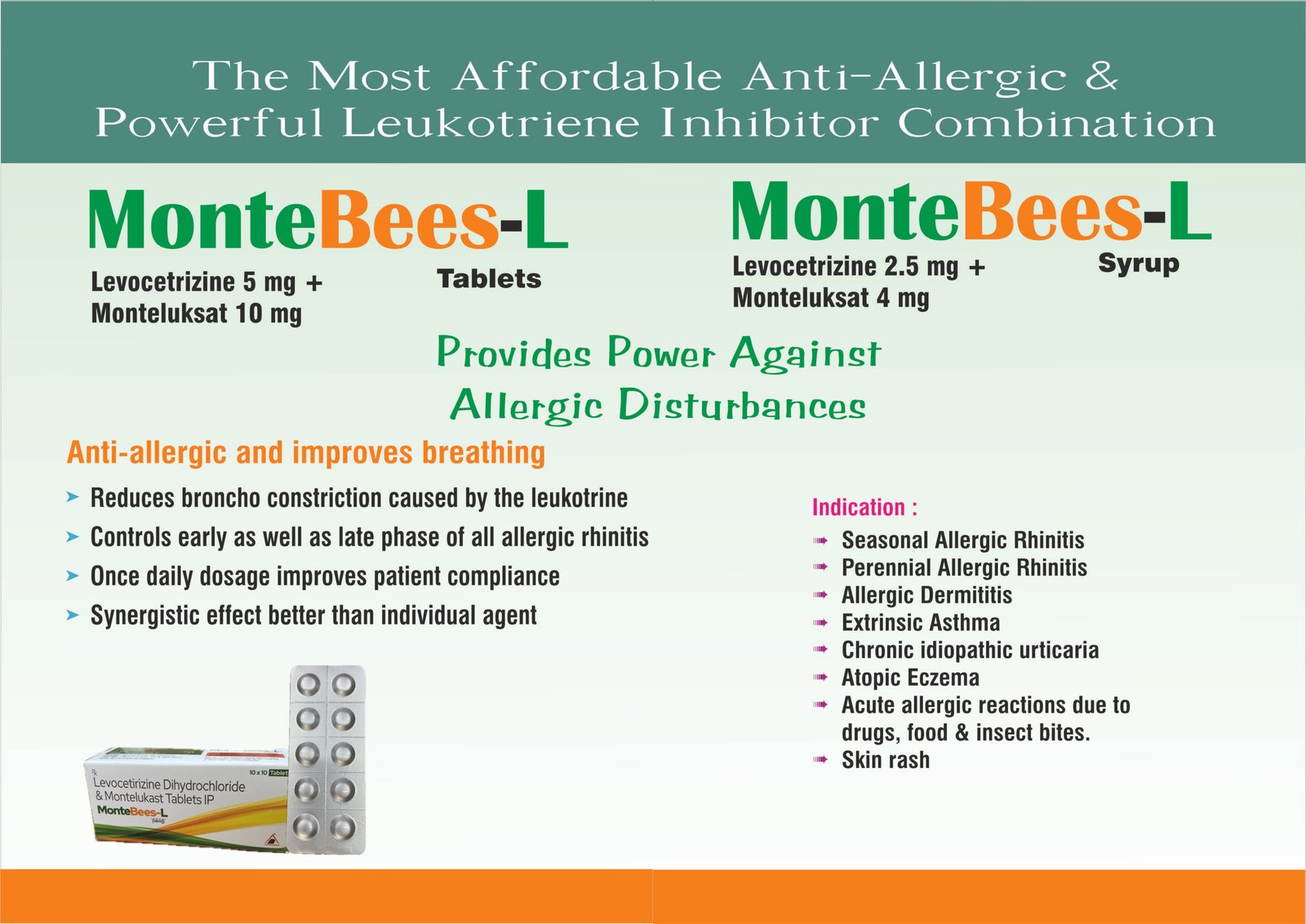
MONTEBEES-L
Product Composition
Packaging Details
Product Description
MONTEBEES-L Tablets
Levocetirizine Hydrochloride 5 mg + Montelukast Sodium 10 mg
MONTEBEES-L is a prescription combination tablet containing Levocetirizine Hydrochloride 5 mg and Montelukast Sodium 10 mg. The combination provides antihistaminic activity together with leukotriene-receptor blockade and may be prescribed for selected allergic conditions where both mechanisms are considered clinically appropriate.
1. Product Information
| Particular | Details |
|---|---|
| Brand Name | MONTEBEES-L |
| Dosage Form | Uncoated Tablets |
| Composition | Levocetirizine Hydrochloride + Montelukast Sodium |
| Levocetirizine HCl | 5 mg |
| Montelukast Sodium | 10 mg |
| Excipients | Q.S. |
| Colour | Titanium Dioxide IP |
| Pack Size | 10 × 10 Tablets |
| Category | Anti-allergic / Antihistamine + Leukotriene Receptor Antagonist |
| Prescription Status | Rx |
2. What is MONTEBEES-L used for?
MONTEBEES-L combines two medicines that work through different pathways involved in allergic symptoms:
- Levocetirizine helps control histamine-mediated symptoms such as sneezing, nasal itching, runny nose and itching.
- Montelukast blocks leukotriene D4 receptors and can reduce leukotriene-mediated inflammatory effects involved in allergic rhinitis and asthma.
Depending on the patient’s condition and the prescriber’s assessment, this type of combination may be considered in conditions such as:
- Allergic rhinitis
- Seasonal allergic rhinitis
- Perennial allergic rhinitis
- Nasal allergy symptoms
- Sneezing and nasal itching
- Watery or runny nose
- Allergy-associated nasal congestion
- Selected patients with allergic airway disease, where montelukast is clinically appropriate
The exact indication for MONTEBEES-L as a fixed-dose combination should be confirmed against the current approved prescribing information.
3. How MONTEBEES-L Works
Levocetirizine Hydrochloride 5 mg
Levocetirizine is a second-generation H1-antihistamine.
During an allergic reaction, histamine binds to H1 receptors and contributes to symptoms including:
- Sneezing
- Nasal itching
- Runny nose
- Watery eyes
- Itching
Levocetirizine selectively blocks peripheral H1 receptors, helping reduce these histamine-mediated symptoms.
Montelukast Sodium 10 mg
Montelukast is a leukotriene receptor antagonist.
Leukotrienes are inflammatory mediators involved in airway inflammation and allergic responses. Montelukast blocks the cysteinyl leukotriene receptor, particularly the CysLT1 receptor, thereby reducing leukotriene-mediated effects such as airway inflammation and certain nasal allergy symptoms.
Montelukast is used in asthma and allergic rhinitis, but it is not a rescue medicine for an acute asthma attack.
4. Combined Action
MONTEBEES-L provides two complementary approaches to allergic symptoms:
Histamine pathway → Levocetirizine → reduces histamine-mediated allergy symptoms
Leukotriene pathway → Montelukast → blocks leukotriene-mediated inflammatory effects
This dual mechanism may provide broader control of allergic symptoms in appropriately selected patients.
5. Key Therapeutic Benefits
When prescribed appropriately, the combination may help with:
- Reduction of sneezing
- Reduction of nasal itching
- Reduction of runny nose
- Reduction of allergy-associated symptoms
- Control of histamine-mediated allergic manifestations
- Reduction of leukotriene-mediated inflammatory effects
- Management of selected allergic rhinitis presentations
The response varies between patients, and treatment should be selected according to the clinical diagnosis.
6. Common Clinical Applications
Allergic Rhinitis
Allergic rhinitis can produce:
- Sneezing
- Runny nose
- Nasal congestion
- Nasal itching
- Watery eyes
- Throat irritation
Levocetirizine directly addresses histamine-mediated symptoms, while montelukast provides leukotriene-pathway activity.
Seasonal Allergies
Symptoms triggered by pollen and other seasonal allergens may include recurrent sneezing, nasal discharge and itching.
Perennial Allergic Rhinitis
Symptoms caused by year-round allergens may require longer-term allergy management under medical supervision.
Allergic Airway Disease
Montelukast may be prescribed as part of an asthma-management regimen in appropriate patients. It should not replace prescribed rescue treatment for an acute asthma attack.
7. Suggested Use & Dosage
MONTEBEES-L should be taken only according to the physician’s prescription.
The artwork confirms that each tablet contains:
- Levocetirizine HCl — 5 mg
- Montelukast Sodium — 10 mg
A commonly labelled adult/adolescent dose for the individual medicines may be 5 mg levocetirizine and 10 mg montelukast once daily, but the dosing schedule for this specific fixed-dose combination should follow its approved prescribing information rather than being inferred solely from the artwork.
Do not increase the dose or frequency without medical advice.
8. How to Take MONTEBEES-L
- Take the tablet exactly as prescribed.
- Swallow with water.
- Do not crush or chew unless specifically instructed.
- It may generally be taken with or without food, subject to the product’s prescribing information.
- Take it at approximately the same time each day if prescribed regularly.
- Do not take an additional dose to compensate for a missed dose unless instructed by your healthcare professional.
9. Possible Side Effects
Levocetirizine-related
Possible effects can include:
- Drowsiness
- Fatigue
- Headache
- Dry mouth
- Dizziness
Although levocetirizine is generally considered less sedating than older antihistamines, individual responses vary.
Avoid driving or operating machinery until you know how the medicine affects you.
Montelukast-related
Possible adverse effects can include:
- Headache
- Abdominal discomfort
- Nausea
- Diarrhea
- Upper respiratory symptoms
More importantly, montelukast carries a boxed warning from the U.S. FDA regarding serious neuropsychiatric events.
10. Important Montelukast Safety Warning
Patients and caregivers should be alert for new or worsening behaviour or mood changes while taking montelukast.
Reported neuropsychiatric symptoms include:
- Agitation
- Aggressive behaviour
- Irritability
- Anxiety
- Depression
- Sleep disturbances
- Vivid or abnormal dreams
- Confusion
- Hallucinations
- Restlessness
- Memory problems
- Suicidal thoughts or behaviour
If new neuropsychiatric symptoms or suicidal thoughts/behaviour occur, FDA advises discontinuing montelukast and contacting a healthcare professional immediately. Such events have been reported in patients with and without a previous psychiatric history.
For allergic rhinitis, FDA recommends reserving montelukast for patients who have an inadequate response to or cannot tolerate alternative therapies.
11. Precautions & Warnings
Before taking MONTEBEES-L, inform your doctor if you have:
- Kidney disease
- Liver disease
- A history of psychiatric or behavioural symptoms
- Previous reactions to antihistamines or montelukast
- Other significant medical conditions
- Pregnancy or plans to become pregnant
- Breastfeeding
Kidney impairment
Levocetirizine is substantially eliminated through the kidneys, so dose adjustment may be necessary in renal impairment. Current prescribing information provides progressively lower dosing recommendations according to renal function and does not recommend use in patients with end-stage renal disease/hemodialysis.
12. Drug Interactions
Tell your doctor about all medicines you are currently taking.
Particular attention may be required with:
- Other antihistamines
- Sedatives
- Sleeping medicines
- Medicines that cause drowsiness
- Certain psychiatric medicines
- Alcohol
- Other medicines used for asthma or allergies
Because levocetirizine can cause drowsiness in some people, combining it with other sedating substances may increase impairment.
13. Alcohol and Driving
Alcohol may increase drowsiness or impairment in susceptible patients.
Until the individual response is known, patients should use caution with:
- Driving
- Operating machinery
- Working at heights
- Other activities requiring full alertness
14. Pregnancy & Breastfeeding
If you are pregnant, planning pregnancy or breastfeeding, consult your physician before taking MONTEBEES-L.
The combination should be used during pregnancy or lactation only when the treating healthcare professional determines that treatment is appropriate.
15. Use in Children
The strength shown on the MONTEBEES-L artwork is Levocetirizine 5 mg + Montelukast 10 mg.
Do not assume that the adult-strength combination is appropriate for children simply because the individual ingredients may have paediatric indications at different strengths.
Paediatric use should be determined by the physician according to the child’s age, weight, diagnosis and the approved product information.
16. When to Seek Medical Attention
Seek prompt medical attention for:
- Difficulty breathing
- Facial, lip or tongue swelling
- Severe allergic reaction
- Severe dizziness or fainting
- Significant behavioural changes
- Hallucinations
- Severe depression
- Suicidal thoughts or behaviour
Neuropsychiatric symptoms associated with montelukast require particular attention.
17. Storage
Store MONTEBEES-L:
- At the temperature specified on the product label.
- In a dry place.
- Protected from excessive heat and moisture.
- Away from direct sunlight.
- Out of reach of children.
Keep the tablets in their original packaging until use.
18. Key Features of MONTEBEES-L
MONTEBEES-L Tablets provide:
- Levocetirizine HCl 5 mg
- Montelukast Sodium 10 mg
- Dual antihistamine + leukotriene pathway activity
- Oral tablet dosage form
- Prescription formulation
- Pack of 10 × 10 tablets
- Suitable for physician-directed management of selected allergic conditions
19. Why Choose MONTEBEES-L?
MONTEBEES-L combines two established pharmacological approaches in a single tablet:
Levocetirizine
Targets histamine-mediated allergy symptoms.
Montelukast
Targets leukotriene-mediated inflammatory pathways.
This makes the formulation pharmacologically complementary for selected patients requiring treatment directed at both pathways.
However, montelukast’s neuropsychiatric safety warning should be considered when determining whether its use is appropriate.