Our Products
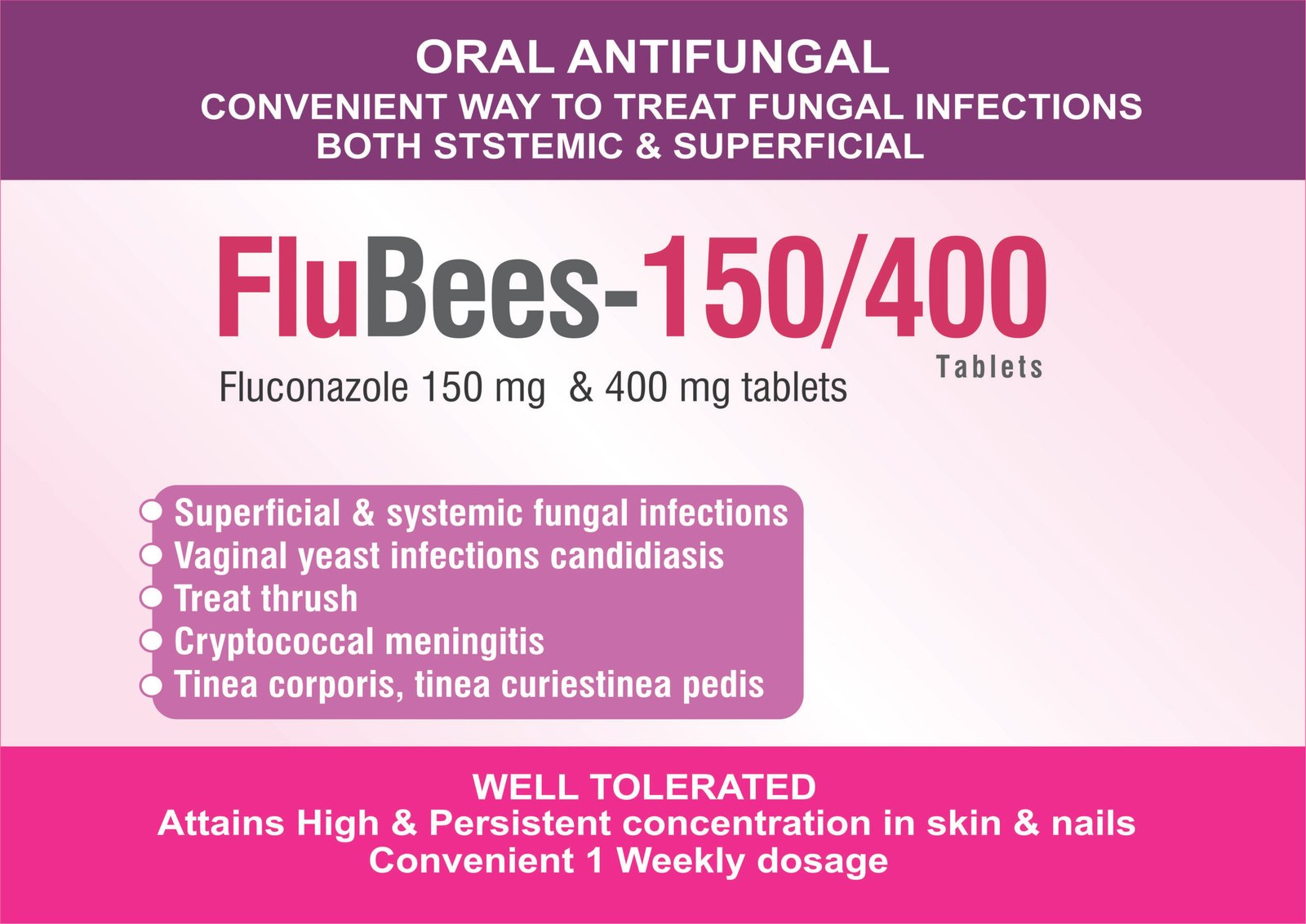
FLUBEES-400
Product Composition
Packaging Details
Product Description
FLUBEES-400 Tablets – Fluconazole IP 400 mg
FLUBEES-400 contains Fluconazole IP 400 mg in an uncoated tablet dosage form. Fluconazole is a triazole antifungal used for selected susceptible fungal infections under medical supervision. The exact dose and duration depend on the infection, organism susceptibility, clinical severity and patient-specific factors such as renal function.
1. Product Information
| Particular | Details |
|---|---|
| Brand Name | FLUBEES-400 |
| Generic Name | Fluconazole Tablets IP |
| Strength | Fluconazole 400 mg |
| Dosage Form | Uncoated Tablet |
| Composition | Each uncoated tablet contains Fluconazole IP 400 mg |
| Excipients | q.s. |
| Therapeutic Category | Antifungal |
| Drug Class | Triazole antifungal |
| Route of Administration | Oral |
| Pack Size | 10 × 5 × 2 Tablets |
| MRP shown on artwork | ₹63.56 / 2 Tablets |
| Prescription Status | Rx |
| Manufacturer/Brand | Amcare |
2. Composition
Each uncoated tablet contains:
Fluconazole IP — 400 mg
Excipients — q.s.
The uploaded artwork specifically establishes the above composition and dosage form.
3. What is FLUBEES-400?
FLUBEES-400 is an oral antifungal tablet containing Fluconazole 400 mg.
Fluconazole belongs to the triazole class of antifungal medicines. It acts against susceptible fungi by interfering with the synthesis of ergosterol, an essential component of the fungal cell membrane.
It may be used in selected cases of:
- Candidemia
- Invasive candidiasis
- Esophageal candidiasis
- Oropharyngeal candidiasis
- Certain Candida urinary tract infections
- Selected cryptococcal infections
- Other susceptible fungal infections
The choice of fluconazole should be based on the infection and susceptibility of the organism. Some Candida species are inherently not susceptible to fluconazole, and acquired resistance can also occur.
4. Mechanism of Action
Fluconazole inhibits the fungal enzyme lanosterol 14-alpha-demethylase, which is involved in the biosynthesis of ergosterol.
Simplified mechanism:
Fluconazole
↓
Inhibits fungal 14-alpha-demethylase
↓
Reduced ergosterol synthesis
↓
Alteration of fungal cell membrane
↓
Inhibition of fungal growth
This mechanism gives fluconazole its antifungal activity against susceptible organisms.
5. Therapeutic Uses
A. Candidemia
Fluconazole can be used in selected patients with candidemia when the patient is clinically appropriate for fluconazole and the Candida isolate is unlikely to be resistant.
IDSA guidance describes 800 mg loading followed by 400 mg daily as an alternative initial regimen in selected patients who are not critically ill and are unlikely to have fluconazole-resistant Candida.
Important: This does not mean that every patient taking FLUBEES-400 should automatically receive one tablet daily. The treating physician determines the regimen.
B. Esophageal Candidiasis
Fluconazole is an established systemic treatment for esophageal candidiasis.
IDSA guidance lists:
200–400 mg once daily for 14–21 days
for oral fluconazole treatment.
C. Oropharyngeal Candidiasis
Fluconazole may be prescribed for susceptible Candida infections involving the mouth and oropharyngeal region.
Treatment should be determined according to:
- Severity
- Site of infection
- Candida species
- Susceptibility
- Patient-specific factors
D. Candida Urinary Tract Infections
Fluconazole achieves high urinary concentrations because it is substantially eliminated through the kidneys.
However, 400 mg is not necessarily the appropriate dose for every Candida urinary infection. The dose and duration should follow the physician’s diagnosis and current treatment guidance.
E. Cryptococcal Infection
Fluconazole has activity against susceptible Cryptococcus species and is used in selected treatment, consolidation or maintenance regimens.
Serious cryptococcal infections require specialist-directed antifungal treatment and should not be treated by selecting a dose solely according to the tablet strength.
6. Clinical Applications
FLUBEES-400 may be considered by healthcare professionals when systemic fluconazole therapy is appropriate for a susceptible infection.
Clinical decision-making may involve:
- Identification of fungal species
- Antifungal susceptibility
- Site of infection
- Severity of disease
- Previous azole exposure
- Renal function
- Hepatic function
- Other medicines being taken
- Immune status
- Clinical response
For bloodstream Candida infections, IDSA recommends susceptibility testing for clinically relevant Candida isolates.
7. Dosage and Administration
Important dosage statement
FLUBEES-400 contains 400 mg of fluconazole per tablet, but 400 mg is not a universal dosage for all fungal infections.
Different infections require different regimens.
For example, IDSA guidance includes:
| Clinical situation | Example fluconazole regimen |
|---|---|
| Selected candidemia | 800 mg loading dose, then 400 mg daily |
| Esophageal candidiasis | 200–400 mg daily for 14–21 days |
| Selected step-down therapy | 400 mg daily in appropriate patients |
| Other fungal infections | Dose varies according to diagnosis |
These examples are clinical guideline regimens and not a substitute for the product’s approved prescribing information or individual medical advice.
Recommended website wording
8. How to Take FLUBEES-400
Fluconazole tablets can generally be taken with or without food. Food does not significantly affect oral absorption.
Administration
- Swallow with water.
- Take at approximately the same time each day when prescribed as a daily regimen.
- Do not stop treatment early unless instructed by the physician.
- Do not take an additional tablet to compensate for a missed dose without appropriate medical advice.
9. Renal Dose Adjustment
Fluconazole is primarily eliminated through the kidneys.
For patients receiving multiple doses, dose adjustment is generally required when renal function is impaired.
General prescribing information provides:
| Creatinine Clearance | General multiple-dose adjustment |
|---|---|
| >50 mL/min | 100% of recommended dose |
| ≤50 mL/min, not on dialysis | 50% of recommended dose |
| Regular hemodialysis | 100% of recommended dose after dialysis |
These are general pharmacokinetic recommendations. The physician must determine the actual regimen based on the infection and patient’s clinical condition.
10. Side Effects
Possible adverse effects include:
Commonly reported
- Headache
- Nausea
- Vomiting
- Abdominal discomfort
- Diarrhoea
- Dyspepsia
- Dizziness
- Skin rash
Important but less common
- Abnormal liver enzymes
- Hepatitis
- Serious hepatic injury
- QT prolongation
- Serious cardiac rhythm abnormalities
- Severe skin reactions
- Hypersensitivity reactions
- Seizures
- Adrenal insufficiency
Rare serious hepatic toxicity, including fatalities, has been reported, particularly among patients with serious underlying illnesses.
11. Liver Precautions
Patients with liver disease should inform their doctor before using FLUBEES-400.
Medical attention should be sought if symptoms suggest liver injury, such as:
- Yellowing of the skin or eyes
- Dark urine
- Persistent nausea
- Loss of appetite
- Severe weakness
- Significant abdominal symptoms
- Unusual itching
Fluconazole should be used cautiously in patients with hepatic dysfunction.
12. Cardiac / QT Precautions
Fluconazole can prolong the QT interval in susceptible patients.
Extra caution may be required in patients with:
- Existing QT prolongation
- Significant cardiac disease
- Hypokalaemia
- Hypomagnesaemia
- Advanced heart failure
- Other medicines that prolong QT
Rare cases of torsades de pointes have been reported.
Patients should tell their physician about any history of significant heart rhythm problems.
13. Drug Interactions
Fluconazole can interact with several medicines because it inhibits cytochrome P450 enzymes.
Depending on the specific formulation and prescribing information, clinically important interactions can involve CYP2C9, CYP2C19 and CYP3A4 substrates. The inhibitory effect can persist for several days after discontinuation.
Examples of medicines/classes requiring attention include:
- Warfarin and other coumarin anticoagulants
- Certain oral antidiabetic medicines
- Phenytoin
- Cyclosporine
- Tacrolimus
- Certain statins
- Some benzodiazepines
- Certain antiarrhythmics
- Other QT-prolonging medicines
The patient’s complete medication list should be reviewed before treatment.
14. Contraindications
FLUBEES-400 should not be used in patients with:
- Known hypersensitivity to fluconazole
- Known hypersensitivity to an excipient in the formulation
Certain combinations with QT-prolonging medicines may also be contraindicated depending on the medicine involved.
15. Pregnancy
Pregnancy requires particular medical consideration.
Available labeling describes rare reports of a characteristic pattern of congenital abnormalities following high-dose fluconazole exposure of 400–800 mg/day during most or all of the first trimester.
The risk-benefit assessment depends on the infection, dose, duration and alternatives available.
16. Breastfeeding
Fluconazole passes into breast milk.
The decision to use FLUBEES-400 during breastfeeding should take into account:
- Maternal indication
- Dose
- Duration
- Infant age
- Infant health
Consult a qualified healthcare professional before use.
17. Pediatric Use
The appropriate pediatric fluconazole dose is generally based on factors such as:
- Age
- Body weight
- Infection
- Severity
- Renal function
The 400 mg tablet should not be administered to a child simply because the adult product is available in that strength.
Pediatric treatment should be physician-directed.
18. Use in Elderly Patients
Elderly patients may have reduced renal function and may also take multiple medicines.
Before prescribing FLUBEES-400, clinicians may consider:
- Renal function
- Hepatic function
- Drug interactions
- Cardiac risk
- Concomitant medicines
Renal adjustment may be required for multiple-dose treatment.
19. Driving and Machinery
Some patients may experience:
- Dizziness
- Rarely, seizures
Patients should avoid driving or operating machinery if these effects occur or if they feel impaired.
20. Seek Immediate Medical Attention If
Severe allergic reaction
- Difficulty breathing
- Facial or throat swelling
- Severe rash
- Swelling of lips or tongue
Severe skin reaction
- Blistering
- Skin peeling
- Extensive rash
- Mouth/eye involvement
Possible liver injury
- Yellow eyes or skin
- Dark urine
- Severe weakness
- Persistent vomiting
Possible cardiac rhythm problem
- Fainting
- Severe palpitations
- Unusual rapid or irregular heartbeat
21. Key Product Features
Fluconazole IP 400 mg
A systemic triazole antifungal for physician-directed treatment of selected susceptible fungal infections.
Oral Tablet
Convenient oral dosage form.
Broad Clinical Use
Fluconazole is used in several Candida infections and selected other susceptible fungal diseases.
Good Oral Absorption
Fluconazole is well absorbed orally, with oral exposure approaching that achieved intravenously.
Physician-Directed Strength
The 400 mg strength can be incorporated into specific antifungal regimens when clinically appropriate.
22. Why FLUBEES-400?
FLUBEES-400 provides:
- Fluconazole IP 400 mg
- Triazole antifungal therapy
- Oral tablet formulation
- A strength used in selected systemic antifungal regimens
- Convenient administration
- Suitable for physician-directed antifungal treatment
The choice of therapy should always be based on the diagnosed infection and susceptibility rather than tablet strength alone.