Our Products
Laxidol
Product Composition
Packaging Details
Product Description
LAXIDOL Suspension
Liquid Paraffin 1.25 mL + Milk of Magnesia 3.75 mL + Sodium Picosulfate 3.33 mg per 5 mL
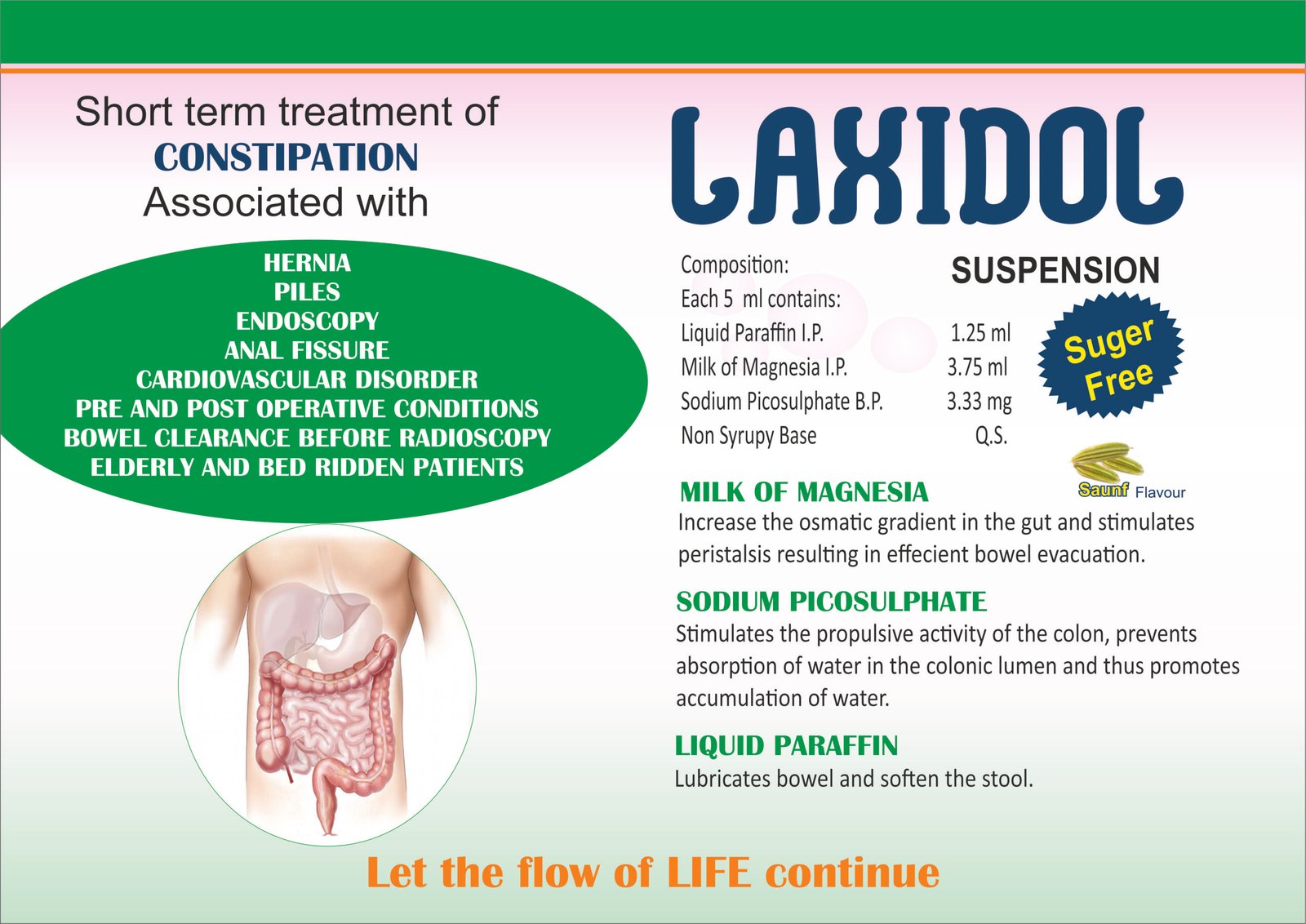
LAXIDOL Suspension is a sugar-free oral laxative formulation containing Liquid Paraffin, Milk of Magnesia and Sodium Picosulfate. The three ingredients provide complementary laxative actions: lubrication, osmotic softening and stimulation of intestinal movement.
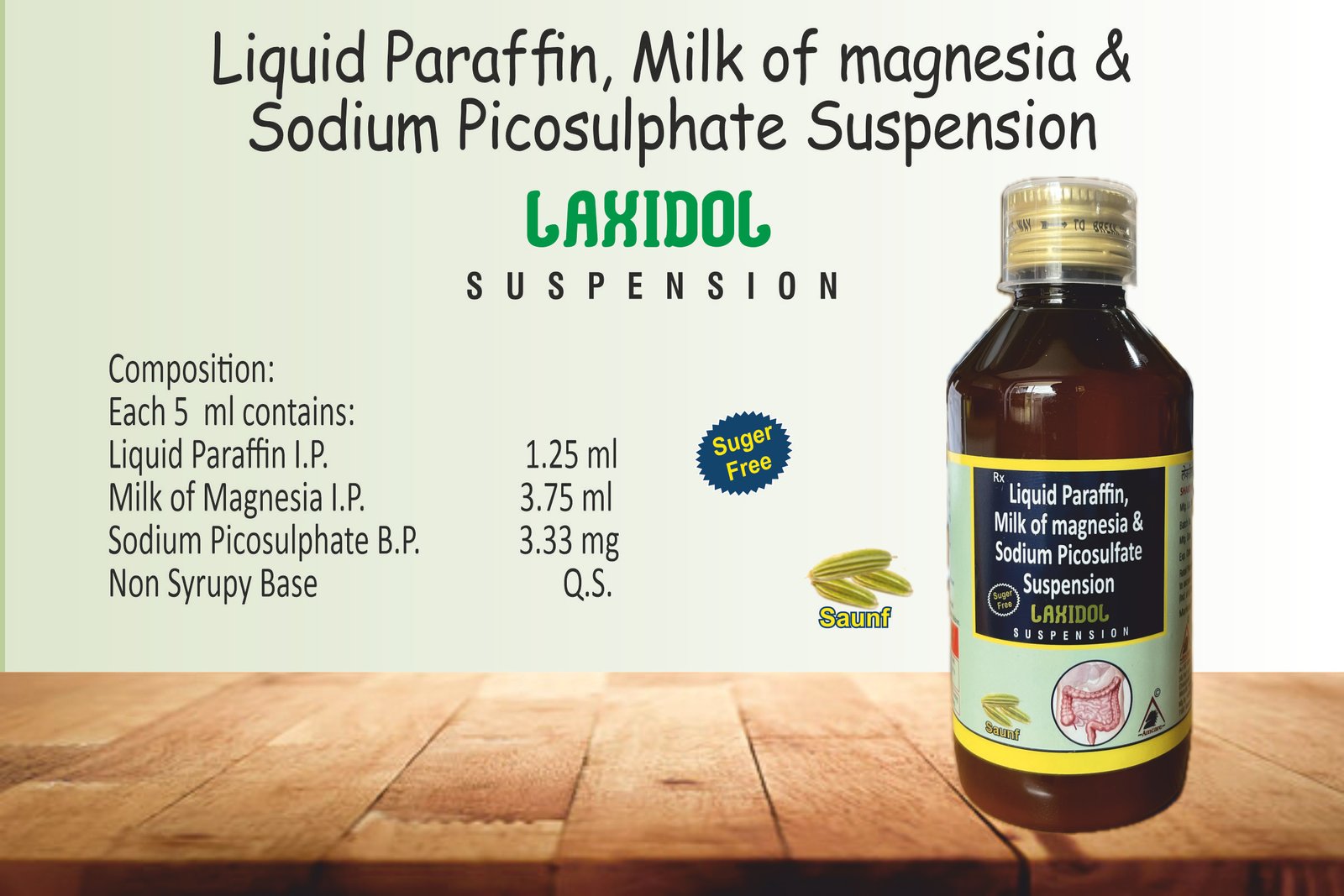
The uploaded artwork clearly shows Rx, Sugar Free, and Saunf flavouring. The artwork does not clearly show the bottle volume, so I have not assumed a pack size.
1. Product Information
| Parameter | Details |
|---|---|
| Brand Name | LAXIDOL Suspension |
| Dosage Form | Oral Suspension |
| Therapeutic Category | Laxative |
| Liquid Paraffin IP | 1.25 mL / 5 mL |
| Milk of Magnesia IP | 3.75 mL / 5 mL |
| Sodium Picosulfate BP | 3.33 mg / 5 mL |
| Base | Non-syrupy base |
| Flavour | Saunf |
| Sugar Status | Sugar Free |
| Route | Oral |
| Prescription marking on artwork | Rx |
| Pack Size | Not visible on supplied artwork |
2. Composition
Each 5 mL contains:
- Liquid Paraffin IP – 1.25 mL
- Milk of Magnesia IP – 3.75 mL
- Sodium Picosulfate BP – 3.33 mg
- Non-Syrupy Base – q.s.
Product characteristics
- Sugar Free
- Saunf flavour
- Oral suspension
- Three-way laxative formulation
- Intended for constipation management
3. What is LAXIDOL Suspension Used For?
LAXIDOL is intended for the relief of constipation.
Constipation may involve:
- Infrequent bowel movements
- Hard or dry stools
- Difficulty passing stools
- Straining during bowel movements
- A feeling of incomplete bowel evacuation
Sodium picosulfate is a stimulant laxative used for short-term relief of occasional constipation, while magnesium hydroxide is a saline laxative used for occasional constipation.
The exact indication and duration of treatment for LAXIDOL should follow the product’s approved prescribing information.
4. How LAXIDOL Works
LAXIDOL combines three different approaches to bowel evacuation:
1. Liquid Paraffin
Lubricant action
2. Milk of Magnesia
Osmotic/saline laxative action
3. Sodium Picosulfate
Stimulant laxative action
Overall concept
Lubricates stool + increases water in the bowel + stimulates intestinal movement
This combination can facilitate softer and easier bowel evacuation.
5. Liquid Paraffin – 1.25 mL
Liquid paraffin, also known as mineral oil, is a lubricant laxative.
It coats the stool and intestinal contents, helping reduce friction and facilitating passage through the bowel.
Simplified action
Liquid Paraffin → lubricates intestinal contents → reduces friction → facilitates stool passage
Its role in the formulation is therefore primarily to make stool passage easier.
6. Milk of Magnesia – 3.75 mL
Milk of Magnesia is a suspension of magnesium hydroxide.
Magnesium hydroxide acts as a saline/osmotic laxative. It retains water within the gastrointestinal tract, helping soften stool and promote bowel movement.
Magnesium hydroxide is officially described as a saline laxative for occasional constipation, and some labels report bowel movement typically within about ½ to 6 hours, although the response can vary between individuals and formulations.
Simplified action
Magnesium Hydroxide → increases water in bowel → softens stool → facilitates bowel movement
7. Sodium Picosulfate – 3.33 mg
Sodium picosulfate is a stimulant laxative.
It increases intestinal activity, promoting bowel movement.
The current UK patient information for sodium picosulfate describes it as a stimulant laxative that increases bowel movements and is used for short-term occasional constipation.
Simplified action
Sodium Picosulfate → stimulates intestinal activity → increases bowel movement → facilitates evacuation
8. Combined Action
The three ingredients complement one another:
| Ingredient | Primary Action |
|---|---|
| Liquid Paraffin | Lubricates stool and intestinal contents |
| Milk of Magnesia | Osmotic/saline laxative; helps soften stool |
| Sodium Picosulfate | Stimulates intestinal movement |
Overall action
Lubrication + stool softening + bowel stimulation
This provides a multi-mechanism approach to constipation management.
9. Potential Therapeutic Benefits
When appropriately prescribed, LAXIDOL may help:
- Relieve occasional constipation
- Facilitate passage of hard stools
- Reduce difficulty during bowel evacuation
- Improve bowel movement frequency
- Promote easier stool passage
- Provide complementary laxative actions
The product should be positioned as a constipation-relief medicine, rather than as a weight-loss product.
Sodium picosulfate products specifically state that they are laxatives for constipation and should not be used for weight loss.
10. Suggested Dosage
The artwork provides the composition per 5 mL, but it does not provide a dosage schedule.
Therefore, for the commercial website, I recommend:
Dosage and duration should be taken as directed by the physician. Do not exceed the recommended dose.
I would not publish a fixed adult dose for LAXIDOL until you confirm the dosage stated in your approved product insert/PI.
This is particularly important because the product contains three laxative ingredients, and excessive laxative use can result in diarrhoea, dehydration and electrolyte disturbances.
11. How to Take LAXIDOL
- Shake the suspension well before use.
- Measure the required quantity accurately.
- Use a measuring cup/spoon rather than an ordinary household spoon.
- Take only the prescribed/recommended quantity.
- Maintain adequate fluid intake unless fluid restriction has been advised by a doctor.
- Do not take additional laxatives without medical advice.
- Do not use continuously for prolonged periods without medical review.
Comparable magnesium hydroxide suspensions specifically instruct patients to shake well before use and not to exceed the recommended daily dose.
12. Expected Onset of Action
The response depends on the individual and the exact formulation.
Magnesium hydroxide products commonly produce a bowel movement within approximately ½ to 6 hours, while sodium picosulfate oral liquids are generally used as short-term stimulant laxatives.
Website wording:
The onset of bowel movement may vary depending on the individual, dose and clinical condition.
Avoid claiming “instant constipation relief” or guaranteeing a specific onset time for LAXIDOL.
13. Common Side Effects
Possible adverse effects include:
Gastrointestinal
- Abdominal cramps
- Abdominal discomfort
- Loose stools
- Diarrhoea
- Nausea
- Increased bowel movements
- Bloating
Excessive laxative activity may result in significant diarrhoea and fluid loss.
14. Important Safety Information
LAXIDOL should not be used simply to treat unexplained abdominal symptoms.
Seek medical advice before use if the patient has:
- Severe abdominal pain
- Nausea or vomiting
- Suspected intestinal obstruction
- Severe dehydration
- Rectal bleeding
- A sudden change in bowel habits
- Persistent constipation
- Inflammatory bowel disease
- Significant kidney disease
Sodium picosulfate patient information specifically warns against use in conditions such as intestinal obstruction, ileus, severe dehydration, serious abdominal conditions and severe abdominal pain with nausea/vomiting.
15. Kidney Disease
This is an important precaution because the product contains Milk of Magnesia, a magnesium-containing laxative.
Patients with kidney disease may have impaired magnesium elimination.
Magnesium hydroxide product labeling advises patients with kidney disease to consult a doctor before use.
Recommended website statement:
Patients with kidney disease should consult their physician before using LAXIDOL.
16. Dehydration and Electrolyte Imbalance
Excessive or prolonged use of laxatives can result in:
- Dehydration
- Excessive diarrhoea
- Weakness
- Electrolyte abnormalities
- Dizziness
- Reduced blood pressure in severe cases
This risk is particularly important when multiple laxative mechanisms are combined.
Do not exceed the recommended dose.
17. Drug Interactions
Patients should inform their doctor or pharmacist about all medicines they are taking.
Particular attention may be required with medicines that:
- Are sensitive to changes in gastrointestinal absorption
- Can cause electrolyte abnormalities
- Affect kidney function
- Require stable electrolyte levels
- Have a narrow therapeutic index
Magnesium-containing laxatives can interact with certain prescription medicines, and product labeling recommends consulting a doctor or pharmacist when taking prescription drugs.
18. Pregnancy
If pregnant or planning pregnancy:
Consult a healthcare professional before using LAXIDOL.
Constipation during pregnancy should preferably be managed with appropriate dietary, fluid and lifestyle measures first, with medicines selected according to clinical need.
19. Breastfeeding
Consult a healthcare professional before using LAXIDOL while breastfeeding.
The clinician should consider the complete three-component formulation and the patient’s individual circumstances.
20. Elderly Patients
Older adults may have increased susceptibility to:
- Dehydration
- Electrolyte disturbances
- Kidney impairment
- Drug interactions
Repeated or prolonged laxative use should therefore be medically reviewed.
21. Children
Do not automatically use the adult formulation or adult dosage in children.
Recommended website wording:
Use in children should be only on the advice of a qualified healthcare professional.
The appropriate paediatric dose and minimum age for LAXIDOL should be taken from the approved product information.
22. Long-Term Use
LAXIDOL should not be positioned as a medicine for indefinite daily use.
For sodium picosulfate products, persistent constipation or the need for continued laxative treatment warrants medical evaluation. One current patient leaflet advises medical review if the patient does not improve or becomes worse after five days.
Magnesium hydroxide labeling similarly advises medical review when a laxative is needed for more than one week.
Website wording:
If constipation persists or repeatedly returns, consult a physician to identify the underlying cause rather than continuing laxative treatment without evaluation.
23. When to Seek Immediate Medical Attention
Stop self-treatment and seek medical attention if there is:
- Severe or persistent abdominal pain
- Abdominal swelling with inability to pass stool or gas
- Persistent vomiting
- Rectal bleeding
- Black/tarry stools
- Severe diarrhoea
- Signs of dehydration
- Severe weakness or dizziness
- No bowel movement despite appropriate treatment
Rectal bleeding or failure to have a bowel movement after laxative use can indicate a condition requiring medical evaluation.
24. LAXIDOL and Constipation
Constipation can have many causes, including:
- Low dietary fibre
- Insufficient fluid intake
- Reduced physical activity
- Changes in routine
- Certain medicines
- Older age
- Underlying gastrointestinal disorders
Sodium picosulfate patient information recommends measures such as adequate fluid intake, dietary fibre, exercise and responding to the natural urge to empty the bowel as part of constipation management.
LAXIDOL should therefore be used as part of an appropriate constipation-management strategy rather than as a substitute for addressing lifestyle or underlying causes.
25. Lifestyle Measures for Constipation
Patients may benefit from:
Adequate fluids
Drink sufficient water unless medically restricted.
Fibre-rich diet
Include appropriate quantities of:
- Fruits
- Vegetables
- Whole grains
- Pulses
Physical activity
Regular movement can support normal bowel function.
Regular toilet routine
Do not repeatedly ignore the urge to pass stool.
These measures can help prevent recurrent constipation.
26. Sugar-Free Formulation
The uploaded artwork specifically states:
SUGAR FREE
This can be highlighted as a product feature.
However, sugar-free should not be presented as a claim that LAXIDOL is automatically suitable for every person with diabetes. Patients should consider the complete formulation and follow professional advice.
27. Saunf Flavour
The artwork displays:
Saunf
This can be described as the product’s flavour profile.
Website wording:
LAXIDOL Suspension is presented as a sugar-free suspension with Saunf flavour.
28. Storage
Store LAXIDOL:
- In a cool, dry place
- Away from direct sunlight
- Away from excessive heat
- In the original, tightly closed container
- Out of reach of children
- According to the storage conditions printed on the final marketed pack
Do not use after the expiry date.
29. Key Product Features
LAXIDOL Suspension
Three-way laxative formulation
- Liquid Paraffin 1.25 mL / 5 mL
- Milk of Magnesia 3.75 mL / 5 mL
- Sodium Picosulfate 3.33 mg / 5 mL
Additional features
- Sugar Free
- Saunf flavour
- Oral suspension
- Lubricant laxative component
- Osmotic/saline laxative component
- Stimulant laxative component
30. Why LAXIDOL?
LAXIDOL combines three complementary laxative mechanisms in a single oral suspension.
1. Lubrication
Liquid Paraffin
Helps facilitate stool passage.
2. Osmotic action
Milk of Magnesia
Helps increase water in the bowel and soften stool.
3. Stimulant action
Sodium Picosulfate
Stimulates bowel activity and promotes evacuation.
Overall concept
Lubricate + Soften + Stimulate
This is the key product communication for LAXIDOL.