Our Products
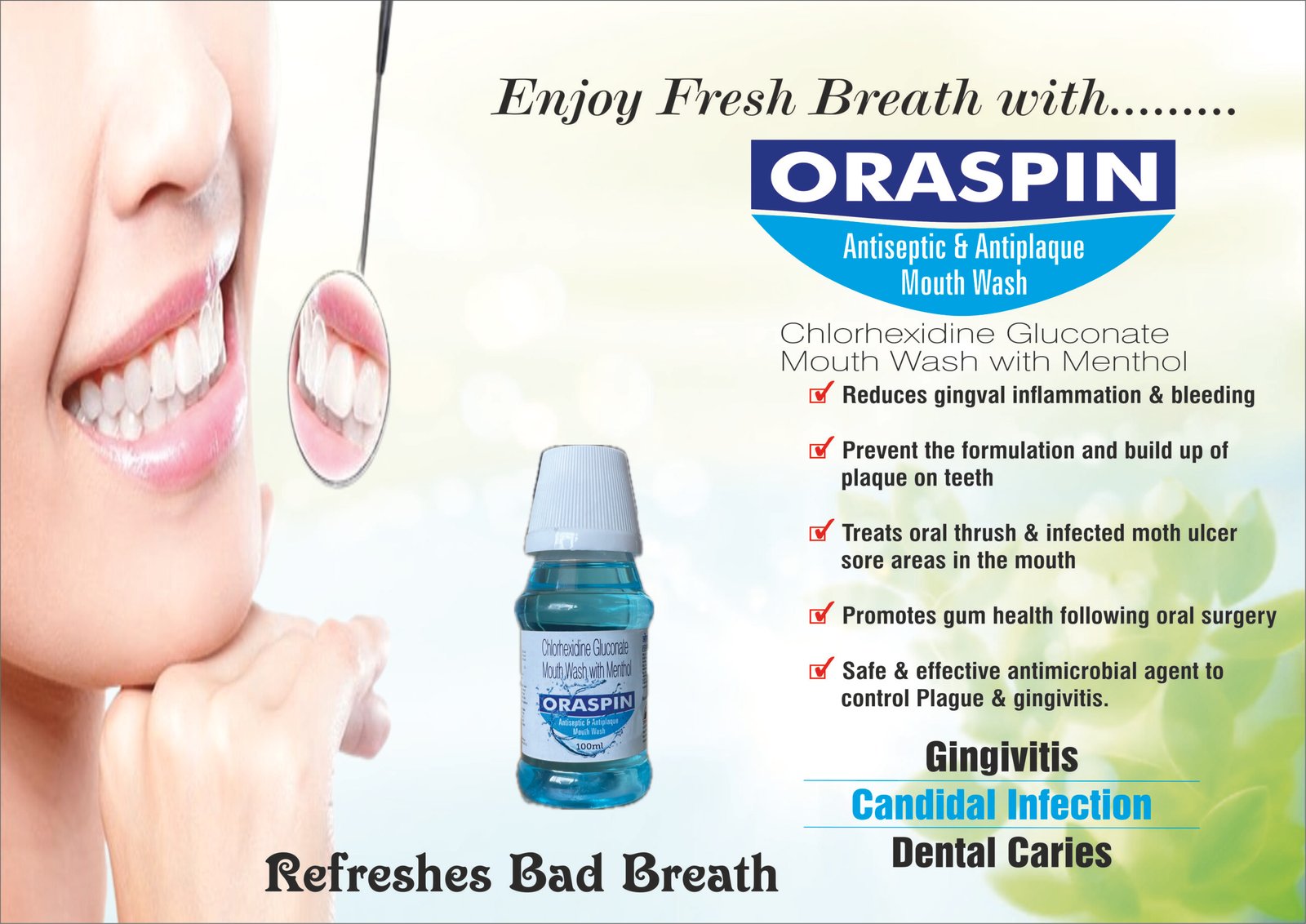
ORASPIN
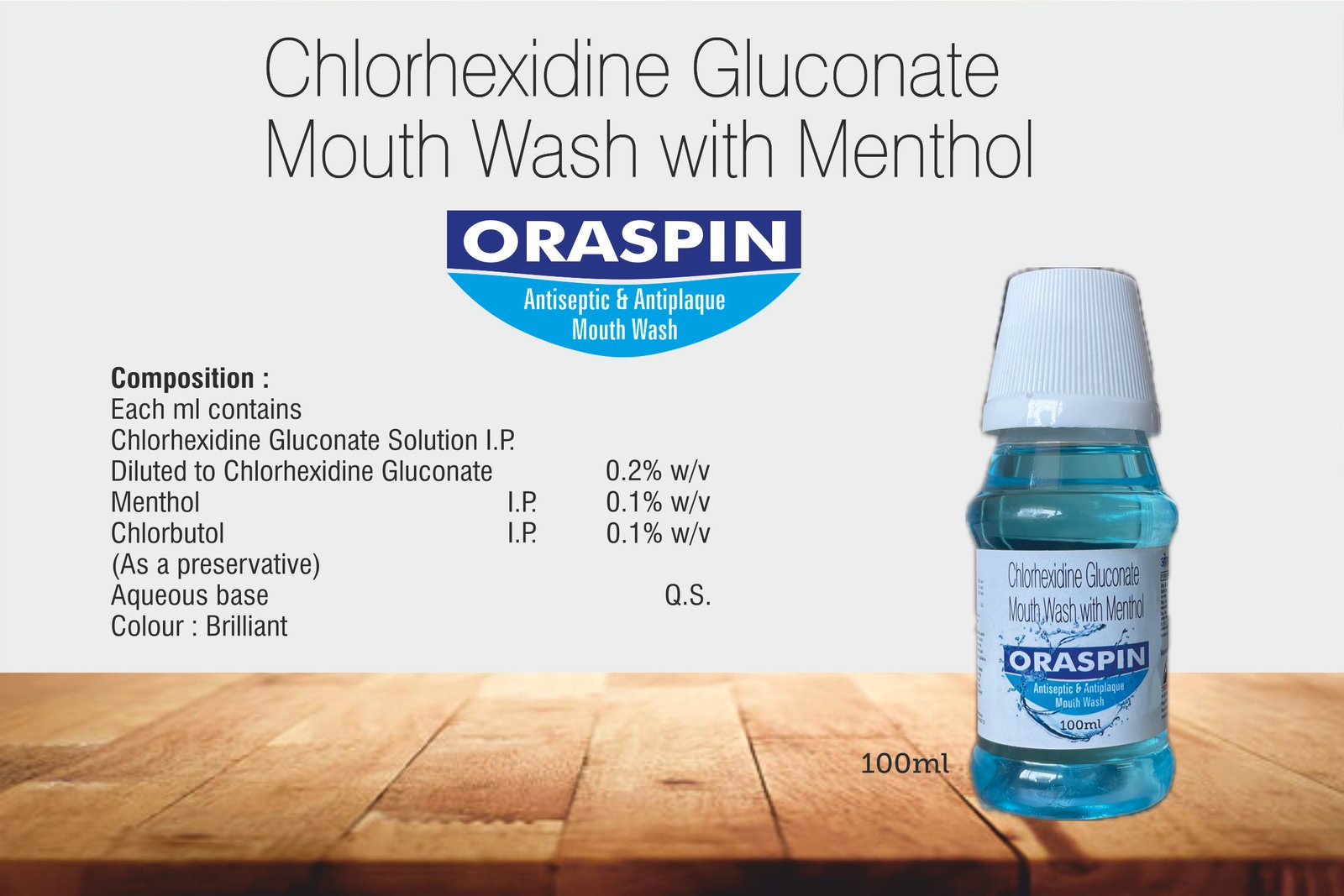
Product Composition
Packaging Details
Product Description
ORASPIN Mouth Wash – Chlorhexidine Gluconate 0.2% w/v + Menthol 0.1% w/v
ORASPIN Mouth Wash is an antiseptic and antiplaque mouthwash containing Chlorhexidine Gluconate 0.2% w/v, with Menthol 0.1% w/v and Chlorbutol 0.1% w/v as a preservative.
Chlorhexidine is a broad-spectrum topical antimicrobial used in oral-care preparations and has evidence for reducing dental plaque and gingival inflammation when used as an adjunct to mechanical oral hygiene.
Product Details
| Parameter | Details |
|---|---|
| Brand Name | ORASPIN |
| Generic Name | Chlorhexidine Gluconate Mouth Wash with Menthol |
| Active Ingredient | Chlorhexidine Gluconate 0.2% w/v |
| Flavouring / Sensory Ingredient | Menthol 0.1% w/v |
| Preservative | Chlorbutol IP 0.1% w/v |
| Dosage Form | Mouth Wash |
| Route | Oral / Dental |
| Base | Aqueous base Q.S. |
| Colour | Brilliant* |
| Pack Size | 100 mL |
| Therapeutic Category | Antiseptic & Antiplaque Mouthwash |
*The artwork states “Colour: Brilliant” but does not specify the complete colour name, so it is better not to expand this on the website without checking the approved artwork/specification.
2. Composition
Each mL contains
- Chlorhexidine Gluconate Solution I.P.
- Diluted to Chlorhexidine Gluconate 0.2% w/v
- Menthol IP – 0.1% w/v
- Chlorbutol IP – 0.1% w/v
- As a preservative
- Aqueous Base – Q.S.
- Colour – as specified on approved formulation/artwork
Active antiseptic
Chlorhexidine Gluconate 0.2% w/v
The 0.2% concentration is a commonly studied chlorhexidine mouthwash concentration. Evidence indicates chlorhexidine mouthrinses can reduce plaque and gingivitis, although staining is an important adverse effect.
3. Therapeutic Category
Antiseptic & Antiplaque Mouthwash
ORASPIN is designed as an adjunct to routine oral hygiene for controlling oral microbial load and dental plaque.
It should not be presented as a replacement for toothbrushing, flossing/interdental cleaning or professional dental treatment.
4. What is ORASPIN Mouth Wash Used For?
ORASPIN may be used under dental/medical guidance as an adjunct in conditions where chlorhexidine oral antisepsis is appropriate, including:
- Gingivitis
- Dental plaque control
- Gingival inflammation
- Oral hygiene following selected dental procedures
- Periodontal-care situations where an antiseptic rinse is indicated
- Situations where mechanical oral hygiene is temporarily difficult
- Selected postoperative oral-care situations as directed by a dentist
Clinical evidence supports chlorhexidine mouthwash as an effective adjunct for reducing plaque and gingival inflammation, particularly over short treatment periods.
5. How Does ORASPIN Work?
Chlorhexidine Gluconate
Chlorhexidine is a cationic antiseptic that interacts with microbial cell membranes.
At appropriate concentrations, it can disrupt microbial membrane integrity and reduce the viability of susceptible oral microorganisms.
Chlorhexidine also has substantial substantivity, meaning it can remain associated with oral surfaces after rinsing, contributing to prolonged antimicrobial activity.
This makes chlorhexidine particularly useful as an adjunct in plaque and gingivitis management.
Menthol
Menthol 0.1% w/v provides:
- Cooling sensation
- Fresh oral sensation
- Flavour enhancement
- Improved mouthwash experience
Menthol should not be described as the primary antimicrobial component of the product.
Chlorbutol
Chlorbutol 0.1% w/v is identified on the artwork as a preservative.
6. Mechanism of Action – Simple Explanation
ORASPIN → Chlorhexidine contacts oral microorganisms → Disruption of microbial cell membranes → Reduced viable oral microbial load → Reduced plaque-associated microbial activity → Support for gingival health
The clinical evidence shows that chlorhexidine mouthrinses can significantly reduce plaque and gingival inflammation compared with control mouthrinses/placebo, although tooth staining occurs more frequently.
7. ORASPIN for Gingivitis
Gingivitis is inflammation of the gums, commonly associated with accumulation of dental plaque.
Chlorhexidine mouthwash can be used as an adjunct to mechanical plaque removal.
Evidence from systematic reviews has demonstrated reductions in plaque and gingival inflammation with chlorhexidine mouthrinses. However, increased extrinsic staining is a recognized trade-off.
Website positioning
ORASPIN may be used as an adjunct to mechanical oral hygiene for the management of plaque-associated gingival inflammation under dental guidance.
8. ORASPIN for Dental Plaque
Dental plaque is a structured microbial biofilm that develops on tooth surfaces.
Regular toothbrushing and interdental cleaning remain the foundation of plaque control.
Chlorhexidine can provide additional antimicrobial plaque control when a mouthwash is clinically indicated.
A systematic review comparing 0.12% and 0.2% chlorhexidine found a small statistical advantage for 0.2% in plaque inhibition, although the authors considered the clinical relevance of the difference probably small.
9. Use After Dental Procedures
A chlorhexidine mouthwash may sometimes be recommended by a dentist after selected dental procedures when routine mechanical cleaning is temporarily difficult or when additional plaque control is desired.
The actual duration and timing should be determined by the dentist according to the procedure and oral condition.
Do not market ORASPIN as automatically required after every dental procedure.
10. Suggested Dosage & Administration
Because the uploaded artwork does not specify a dosage volume or frequency, the website should not state a product-specific dose as though it has been confirmed from the artwork.
Recommended website wording
Dosage: Use ORASPIN Mouth Wash in the quantity and frequency recommended by your dentist or physician. Follow the directions provided with the approved product pack.
For context, NHS guidance for chlorhexidine mouthwash commonly describes 10 mL twice daily, rinsing for approximately one minute and spitting out, but formulations and product instructions can differ.
Therefore, the approved ORASPIN package insert should take precedence over generic chlorhexidine dosing information.
11. How to Use ORASPIN Mouth Wash
- Measure the recommended quantity using the supplied measuring device.
- Rinse thoroughly around the mouth.
- Gargle/rinse as directed by the dentist if appropriate.
- Do not swallow.
- Spit out after rinsing.
- Do not deliberately dilute unless the product instructions specifically require dilution.
- Keep away from children.
NHS guidance similarly advises that chlorhexidine mouthwash should be rinsed around the mouth and spat out rather than swallowed.
12. Important Timing With Toothpaste
Toothpaste ingredients can potentially interfere with chlorhexidine activity.
For this reason, it is prudent to follow the product’s instructions regarding the interval between toothbrushing and chlorhexidine mouthwash.
A practical website instruction can be:
Use ORASPIN according to the advice of your dentist/pharmacist and the approved package instructions. Do not immediately follow chlorhexidine rinsing with another mouthwash unless advised.
The DailyMed chlorhexidine label specifically advises not rinsing with water or another mouthwash immediately after use.
13. Important Warning – Do Not Swallow
ORASPIN is intended for oral rinsing and should be spat out after use.
Do not intentionally swallow the mouthwash.
If a significant amount is accidentally swallowed, especially by a child, seek appropriate medical advice. NHS guidance specifically recommends seeking advice if chlorhexidine mouthwash is swallowed or excessive use causes illness.
14. Side Effects
Possible adverse effects of chlorhexidine mouthwash include:
Oral effects
- Tooth staining
- Tongue discoloration
- Altered taste
- Bitter/medicinal taste
- Oral irritation
- Burning or tingling sensation
- Dry mouth
- Increased calculus/tartar accumulation
Chlorhexidine-associated tooth staining and taste alteration are well documented.
15. Tooth Staining
Tooth staining is one of the most important counselling points for ORASPIN.
Chlorhexidine mouthwash can cause extrinsic discoloration of:
- Teeth
- Tongue
- Dental restorations
The staining can generally be addressed by professional dental cleaning, although some restoration surfaces may be more difficult to clean.
A systematic review also found significantly greater staining with chlorhexidine compared with control treatment.
Recommended website statement
Prolonged or repeated use of chlorhexidine mouthwash may cause temporary extrinsic staining of teeth and tongue. Professional dental cleaning can usually remove much of this staining.
16. Taste Alteration
Some patients may experience:
- Bitter taste
- Altered taste perception
- Temporary changes in the taste of food and beverages
Rare cases of persistent taste alteration have been reported with chlorhexidine oral rinses.
17. Allergic Reactions
Hypersensitivity to chlorhexidine can occur.
Rare but serious allergic reactions, including anaphylaxis, have been reported with dental chlorhexidine products.
Stop use and seek urgent medical attention if there is:
- Facial swelling
- Lip or tongue swelling
- Difficulty breathing
- Wheezing
- Widespread rash
- Severe dizziness or collapse
18. Contraindications / Precautions
ORASPIN should not be used by patients with known hypersensitivity to:
- Chlorhexidine
- Any component of the formulation
Use cautiously and seek professional advice in patients with:
- Significant oral mucosal irritation
- Previous chlorhexidine allergy
- Extensive dental restorations where staining is a concern
- Difficulty reliably spitting out mouthwash
- Conditions where swallowing may occur unintentionally
19. Drug and Product Interactions
Patients should tell their dentist or pharmacist about other oral-care products they use.
Particular attention should be given to:
- Other antiseptic mouthwashes
- Mouthwashes containing incompatible ingredients
- Toothpaste used immediately before chlorhexidine
- Other chlorhexidine-containing products
The product should be used according to its approved instructions rather than combining multiple antiseptic oral products without professional advice.
20. Pregnancy and Breastfeeding
Pregnant or breastfeeding patients should consult their dentist or healthcare professional before using ORASPIN.
Chlorhexidine oral preparations have been used clinically, but product-specific pregnancy and lactation information should be checked against the approved formulation and local prescribing information.
21. Use in Children
Children should use ORASPIN only when they are able to rinse and reliably spit out the product.
Young children may accidentally swallow mouthwash.
Therefore:
Keep ORASPIN out of reach of children and use in paediatric patients only according to professional advice and the approved product information.
Do not publish a specific minimum age unless it is confirmed in the approved ORASPIN package insert.
22. Use in Elderly Patients
No special dose can be established from the artwork alone.
Older adults should follow the same professional instructions, with particular attention to:
- Ability to rinse and spit
- Oral mucosal sensitivity
- Existing dental restorations
- Concurrent oral medications and mouthwashes
23. ORASPIN and Daily Oral Hygiene
ORASPIN should be positioned as an adjunct, not a substitute, for normal oral hygiene.
Recommended oral-care measures include:
- Brush teeth regularly with fluoride toothpaste.
- Clean between teeth using floss/interdental brushes as appropriate.
- Attend regular dental check-ups.
- Use ORASPIN only for the recommended duration.
- Have persistent gum bleeding, swelling or pain evaluated by a dentist.
24. Can ORASPIN Replace Toothbrushing?
No.
Chlorhexidine mouthwash can provide additional antimicrobial plaque control, but mechanical plaque removal remains fundamental to oral hygiene.
ORASPIN should therefore be marketed as:
“An antiseptic and antiplaque mouthwash for use as an adjunct to routine oral hygiene.”
rather than as a replacement for brushing.
25. How Long Should ORASPIN Be Used?
The artwork does not specify treatment duration.
Chlorhexidine is generally used for limited treatment periods when clinically indicated, rather than as an unrestricted long-term daily mouthwash.
This is particularly important because staining and other adverse effects become relevant with continued use. NHS guidance, for example, describes a limited course for gum disease rather than indefinite use.
Recommended website wording
Duration: Use for the duration recommended by your dentist or healthcare professional. Avoid prolonged unsupervised use.
26. Benefits / Therapeutic Role
ORASPIN provides:
- Antiseptic oral action
- Antiplaque support
- Support in management of plaque-associated gingival inflammation
- Chlorhexidine-based oral antimicrobial activity
- Mentholated cooling/fresh sensation
- Convenient liquid mouthwash formulation
Clinical reviews support chlorhexidine’s effectiveness against plaque and gingivitis, while also highlighting tooth staining as a significant adverse effect.
27. Product Features
| Feature | ORASPIN |
|---|---|
| Active antiseptic | Chlorhexidine Gluconate |
| Concentration | 0.2% w/v |
| Menthol | 0.1% w/v |
| Preservative | Chlorbutol IP 0.1% w/v |
| Dosage form | Mouth Wash |
| Base | Aqueous |
| Route | Oral rinse |
| Pack size | 100 mL |
| Therapeutic category | Antiseptic & Antiplaque |
| Brand | ORASPIN |
28. Why Choose ORASPIN?
ORASPIN Mouth Wash combines 0.2% chlorhexidine gluconate with menthol in an aqueous oral-rinse formulation.
Its intended role is to provide additional antiseptic and antiplaque support when chlorhexidine mouthwash is clinically appropriate.
The product should be used for the recommended duration because chlorhexidine can cause tooth staining and taste changes with use.