Our Products
Coffmul® HERBAL SYRUP
Product Composition
Packaging Details
Product Description
COFFMUL Herbal Syrup – Complete Product Information
1. Product Overview
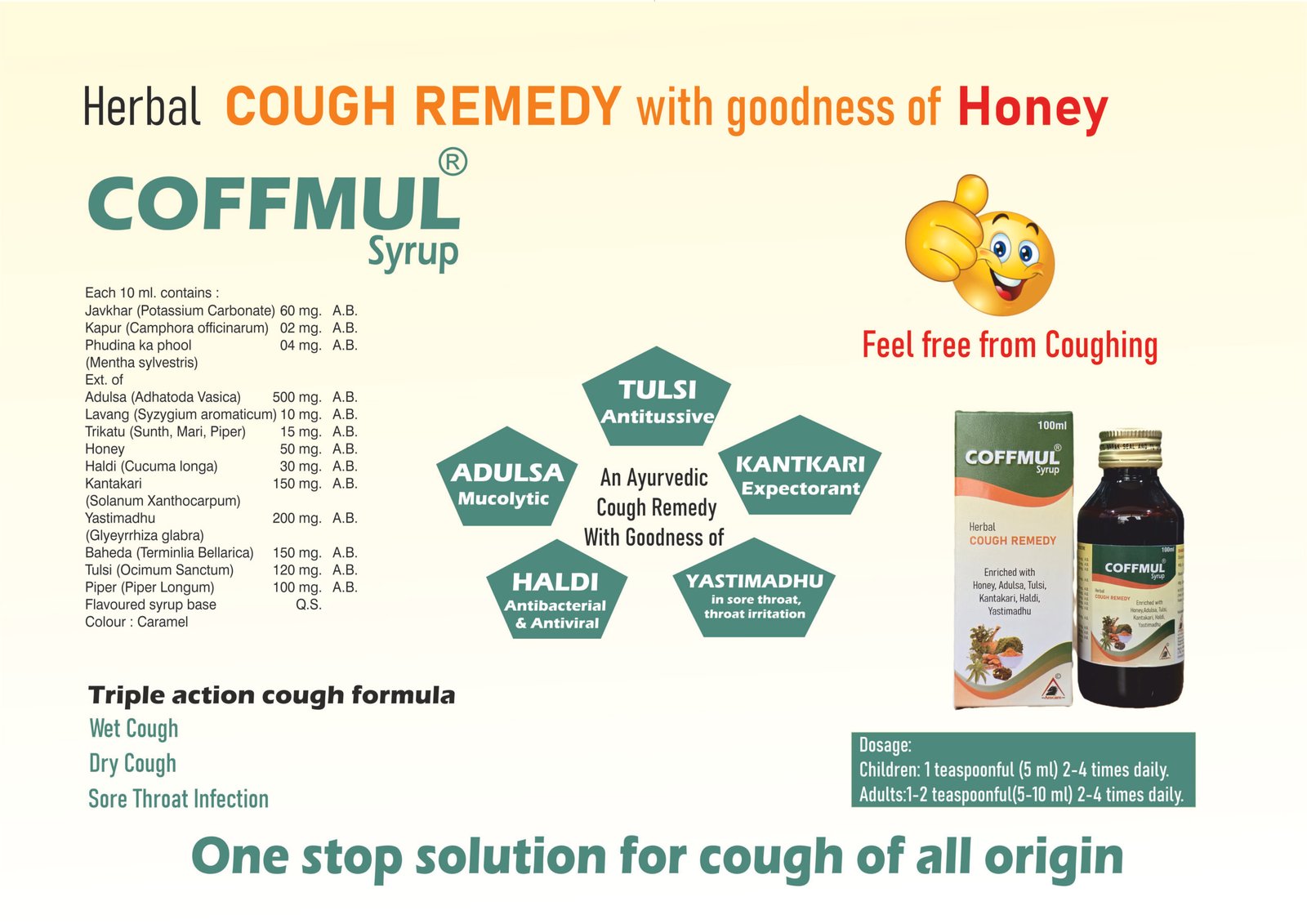
COFFMUL Syrup by Amcare Pharmaceuticals is presented on the supplied packaging as a herbal cough remedy containing a combination of botanical ingredients, honey, camphor and potassium carbonate.
According to the product artwork, each 10 mL contains:
-
Javkhar (Potassium Carbonate) – 60 mg
-
Kapur (Camphor) – 2 mg
-
Phudina ka Phool (Mentha sylvestris) – 4 mg
-
Adulsa Extract (Adhatoda vasica) – 500 mg
-
Lawang (Syzygium aromaticum) – 10 mg
-
Trikatu (Sunth, Mari, Piper) – 15 mg
-
Honey – 50 mg
-
Haldi (Curcuma longa) – 30 mg
-
Kantakari (Solanum xanthocarpum) – 150 mg
-
Yastimadhu (Glycyrrhiza glabra) – 200 mg
-
Baheda (Terminalia bellirica) – 150 mg
-
Tulsi (Ocimum sanctum) – 120 mg
-
Piper (Piper longum) – 100 mg
-
Flavoured Syrup Base – Q.S.
The packaging identifies the syrup as enriched with honey, Adulsa, Tulsi, Kantakari, Haldi and Yastimadhu. It also specifies caramel colour.
Important: The composition is transcribed from the supplied artwork. The botanical ingredients have traditional uses in herbal formulations, but their presence alone does not prove the clinical effectiveness or safety of this particular finished product.
2. Product Composition
|
Ingredient |
Quantity per 10 mL |
|---|---|
|
Javkhar (Potassium Carbonate) |
60 mg |
|
Kapur (Camphor) |
2 mg |
|
Phudina ka Phool (Mentha sylvestris) |
4 mg |
|
Adulsa Extract (Adhatoda vasica) |
500 mg |
|
Lawang (Syzygium aromaticum) |
10 mg |
|
Trikatu (Sunth, Mari, Piper) |
15 mg |
|
Honey |
50 mg |
|
Haldi (Curcuma longa) |
30 mg |
|
Kantakari (Solanum xanthocarpum) |
150 mg |
|
Yastimadhu (Glycyrrhiza glabra) |
200 mg |
|
Baheda (Terminalia bellirica) |
150 mg |
|
Tulsi (Ocimum sanctum) |
120 mg |
|
Piper (Piper longum) |
100 mg |
|
Flavoured Syrup Base |
Q.S. |
The artwork places the abbreviation “A.B.” alongside several ingredients. Its precise meaning should be confirmed from the approved formulation or manufacturer documentation.
Product Details
|
Specification |
Details |
|---|---|
|
Brand Name |
COFFMUL |
|
Product Type |
Herbal cough syrup, as described on the artwork |
|
Dosage Form |
Oral Syrup |
|
Route |
Oral |
|
Composition Basis |
Per 10 mL |
|
Colour |
Caramel |
|
Pack Size |
100 mL |
|
MRP Shown on Artwork |
₹120.00 |
|
Company |
Amcare Pharmaceuticals |
|
Primary Product Positioning |
Herbal Cough Remedy |
The pack size and MRP are based on the supplied image. Confirm the current MRP and registered product category before publication.
3. What Is COFFMUL Herbal Syrup?
COFFMUL Herbal Syrup is marketed as a herbal cough remedy featuring several traditionally used botanical ingredients.
Its formulation includes Adulsa, Tulsi, Kantakari, Yastimadhu, Baheda, Haldi, Trikatu, clove, long pepper, mint and honey.
Several of these ingredients have a history of use in traditional respiratory formulations. For example, Adhatoda vasica has been traditionally used for cough and other respiratory complaints, while licorice root has a long history of traditional use for cough. However, the evidence for individual plants cannot be assumed to demonstrate the efficacy or safety of COFFMUL as a whole.
4. Herbal Ingredient Profile
A. Adulsa Extract – 500 mg per 10 mL
Botanical name shown: Adhatoda vasica
Adulsa, also known as Vasaka, is a traditional medicinal plant used in Indian herbal systems for respiratory complaints.
Traditional role: Respiratory health support.
It has traditionally been used in formulations for:
-
Cough-related complaints
-
Respiratory discomfort
-
Conditions involving mucus
-
Selected bronchial complaints
Adhatoda vasica has been studied for various pharmacological effects, but the quality and relevance of the evidence vary. Safety during pregnancy is a particular consideration because certain constituents have been associated with uterine-stimulating effects.
B. Tulsi – 120 mg per 10 mL
Botanical name shown: Ocimum sanctum
Tulsi is a traditional Indian medicinal herb used in a variety of herbal preparations.
Traditional role: Respiratory wellness support.
Tulsi is traditionally included in formulations intended for cough and common respiratory complaints. Its presence in COFFMUL should not be interpreted as proof that the finished syrup prevents or cures respiratory infections.
C. Kantakari – 150 mg per 10 mL
Botanical name shown: Solanum xanthocarpum
Kantakari is a plant used in traditional Ayurvedic respiratory formulations.
Traditional role: Respiratory symptom support.
It is included in COFFMUL’s herbal combination, alongside Adulsa and other traditional ingredients. The approved product documentation should establish the precise indication and claims permitted for the finished formulation.
D. Yastimadhu – 200 mg per 10 mL
Botanical name shown: Glycyrrhiza glabra
Yastimadhu, also called licorice or liquorice, has traditionally been used in preparations for cough and throat discomfort.
Traditional role: Throat-soothing support.
Licorice is an important ingredient to consider from a safety perspective. Glycyrrhizin in licorice products can contribute to raised blood pressure, low potassium and heart-rhythm complications, particularly with substantial or prolonged exposure and in susceptible individuals. The actual risk from this particular syrup depends on its formulation, the licorice preparation and the amount consumed.
E. Baheda – 150 mg per 10 mL
Botanical name shown: Terminalia bellirica
Baheda is a traditional Ayurvedic botanical included in a variety of polyherbal formulations.
Traditional role: Herbal respiratory formulation support.
Its inclusion contributes to the multi-ingredient character of COFFMUL. Product-specific clinical benefits should not be inferred solely from traditional use.
F. Haldi – 30 mg per 10 mL
Botanical name shown: Curcuma longa
Haldi, or turmeric, is a familiar botanical used in traditional preparations and food.
Traditional role: Botanical support ingredient.
Turmeric contains curcuminoids and other plant constituents that have been investigated for various biological effects. The quantity stated on the label does not establish a therapeutic effect for this finished product.
G. Trikatu – 15 mg per 10 mL
Ingredients named on the artwork: Sunth, Mari and Piper.
Trikatu is a traditional combination generally associated with ginger, black pepper and long pepper.
Traditional role: Warming herbal blend.
The artwork lists Trikatu as a combined ingredient. Its amount should be preserved as 15 mg per 10 mL rather than treating it as 15 mg of each individual spice.
H. Lawang – 10 mg per 10 mL
Botanical name shown: Syzygium aromaticum
Lawang, or clove, is an aromatic botanical used in traditional preparations.
Role in the formulation: Aromatic herbal ingredient.
The supplied artwork lists the ingredient but does not state a separate therapeutic indication for it.
I. Piper – 100 mg per 10 mL
Botanical name shown: Piper longum
Piper longum, commonly called long pepper or Pippali, is used in traditional Indian formulations.
Traditional role: Herbal formulation ingredient.
The artwork lists Piper separately from Trikatu. Both entries should be retained separately in the product’s published composition unless the approved formula specifies otherwise.
J. Phudina ka Phool – 4 mg per 10 mL
Botanical name shown: Mentha sylvestris
This ingredient is identified on the artwork as Phudina ka Phool.
Role in the formulation: Mint-related aromatic ingredient.
Because the precise ingredient form is not specified, the manufacturer should confirm whether the listed quantity represents a flower, extract, oil or another preparation.
K. Honey – 50 mg per 10 mL
Honey is included in the formulation as a listed ingredient.
Role in the formulation: Sweetening and potentially soothing ingredient.
Honey is commonly used in traditional cough preparations. Nevertheless, evidence about one honey-containing formula cannot establish the clinical effectiveness of another formulation.
L. Kapur – 2 mg per 10 mL
Botanical name shown: Camphora officinarum
Kapur, or camphor, is an aromatic ingredient listed in the supplied composition.
Role in the formulation: Aromatic ingredient.
Camphor requires particular caution because excessive ingestion can cause serious poisoning, including seizures. COFFMUL should only be used according to its approved oral dosing instructions, and the bottle must be kept out of children’s reach.
M. Javkhar – 60 mg per 10 mL
Ingredient identified on the artwork: Potassium Carbonate
Javkhar is listed as potassium carbonate in the supplied composition.
Although the product is marketed as a herbal cough remedy, potassium carbonate is not a botanical ingredient. Its presence and concentration should be clearly retained in the formal composition and verified against the approved product formula.
5. What Is COFFMUL Herbal Syrup Marketed For?
The supplied packaging presents COFFMUL as a herbal cough remedy.
Based on that positioning and the traditional uses of some ingredients, the product may be intended for selected cough-related complaints when consistent with its approved indications.
Potential areas of traditional use associated with ingredients in the formulation include:
Cough-Related Complaints
Adulsa, Tulsi and Yastimadhu are traditionally used in certain herbal preparations for cough-related symptoms.
Throat Discomfort
Honey and licorice are commonly used in traditional preparations intended to soothe the throat.
Respiratory Wellness
The combination of several botanicals reflects the formulation’s traditional respiratory positioning.
Important: These descriptions concern traditional ingredient use, not proof that COFFMUL treats a specific disease. Do not claim that it cures asthma, bronchitis, pneumonia or respiratory infections unless those claims are expressly supported by the product’s current authorisation and reliable clinical evidence.
6. How Does COFFMUL Herbal Syrup Work?
Unlike a conventional formulation containing clearly defined pharmacological agents with established mechanisms, COFFMUL is presented as a multi-ingredient herbal preparation.
Its ingredients have different traditional roles, but the supplied artwork does not establish a scientifically validated mechanism for the finished syrup.
At a high level, its formulation can be described as follows:
|
Ingredient group |
Traditional or formulation role |
|---|---|
|
Adulsa, Tulsi and Kantakari |
Traditional respiratory-use botanicals |
|
Yastimadhu and Honey |
Ingredients traditionally included in soothing preparations |
|
Trikatu, Lawang and Piper |
Traditional spice and botanical ingredients |
|
Phudina ka Phool and Kapur |
Aromatic ingredients |
|
Baheda and Haldi |
Additional traditional botanical ingredients |
|
Javkhar |
Non-botanical ingredient listed as potassium carbonate |
|
Flavoured Syrup Base |
Vehicle for the formulation |
These ingredient descriptions should not be interpreted as proof of the clinical effect of the combination. The efficacy and safety of a finished herbal product require product-specific supporting evidence.
7. Product Highlights
1. Multi-ingredient formulation
Contains a combination of botanical ingredients, honey, camphor and potassium carbonate.
2. Traditional herbal positioning
The carton identifies the product as a Herbal Cough Remedy.
3. Adulsa and Tulsi
Two traditional Indian medicinal plants included in the formula.
4. Honey and Yastimadhu
Ingredients traditionally used in some preparations for cough and throat discomfort.
5. Caramel colour
The supplied artwork identifies the colour as caramel.
6. 100 mL pack
The product carton and bottle display 100 mL.
7. MRP shown on artwork
The supplied image shows ₹120.00 as the MRP. Confirm the current legally applicable MRP before publication or commercial use.
8. Dosage and Administration
The supplied artwork specifies ingredient quantities per 10 mL but does not provide a complete dosage schedule.
The dose and duration should be based on the current approved product label, package insert and healthcare professional’s advice.
General precautions:
-
Measure the syrup using an appropriate measuring cup or oral syringe.
-
Do not estimate doses using an ordinary household spoon.
-
Do not exceed the approved dose or frequency.
-
Do not combine it with other herbal or conventional cough medicines without checking for duplication and interactions.
-
Consult a healthcare professional if symptoms persist, recur or worsen.
-
Do not assume that a herbal formulation is automatically suitable for infants or children.
The label information supplied is insufficient to recommend a specific dose or minimum age.
9. Important Safety Information
Herbal Does Not Automatically Mean Safe
Herbal ingredients can have side effects and interact with conventional medicines. Evidence about safety may also vary substantially between individual herbs and finished products.
Camphor
The formula lists camphor at 2 mg per 10 mL. Follow the approved directions exactly and keep the product away from children. Accidental consumption beyond the recommended amount requires urgent medical advice because camphor poisoning can be serious.
Yastimadhu (Licorice)
People with high blood pressure, heart disease or kidney disease should consult a healthcare professional before use because licorice constituents can affect blood pressure and potassium balance, depending on exposure.
Pregnancy and Breastfeeding
Do not assume that this multi-ingredient herbal formulation is suitable during pregnancy or breastfeeding. Obtain medical advice before use. Adulsa also warrants specific caution because safety concerns have been raised about some of its constituents and pregnancy.
Children
Do not infer the appropriate age range from the syrup format. Use in children should follow the product’s approved age restrictions and professional advice.
10. Possible Side Effects
The supplied artwork does not provide a product-specific adverse-effect list, so the exact side-effect profile of COFFMUL cannot be established from the image alone.
Potential issues associated with individual ingredients or herbal products may include:
-
Gastrointestinal discomfort
-
Nausea or vomiting
-
Allergic reactions or skin rashes
-
Interactions with other medicines
-
Blood-pressure or potassium-related effects associated with licorice exposure
-
Serious toxicity following excessive camphor ingestion
The likelihood of these effects depends on the ingredients, preparation, dose, duration and individual susceptibility. Licorice-related risks are particularly relevant to people with hypertension and heart or kidney disease.
11. Precautions
Consult a healthcare professional before using COFFMUL if the intended user:
-
Is pregnant or breastfeeding
-
Is an infant or young child
-
Has high blood pressure
-
Has heart or kidney disease
-
Takes medicines regularly
-
Has a known allergy to any ingredient
-
Has a persistent or unexplained cough
-
Has severe or worsening respiratory symptoms
The complete contraindications and precautions should be verified from the approved COFFMUL product documentation.
12. Drug and Herbal Interactions
The full interaction profile of this combination cannot be established from the supplied image alone.
Before use, tell the healthcare professional about other medicines and herbal preparations being taken.
Licorice-Containing Products
Licorice can interact with certain medicines, including corticosteroids, and may influence blood pressure and electrolyte balance.
Other Herbal Products
Combining multiple herbal preparations can lead to overlapping ingredients or unexpected interactions. Herbal products are not necessarily free from adverse effects.
Other Cough Medicines
Avoid taking multiple cough preparations together unless a qualified professional has assessed their combined ingredients.
13. When to Consult a Doctor
Medical evaluation is recommended if the cough:
-
Persists or becomes worse
-
Is associated with difficulty breathing
-
Is accompanied by chest pain
-
Produces blood
-
Occurs with persistent or high fever
-
Is accompanied by wheezing or significant weakness
Seek urgent medical care if breathing difficulty is severe, a serious allergic reaction occurs or an overdose is suspected.
14. Storage and Handling
Store COFFMUL according to the conditions printed on the approved product label.
General precautions include:
-
Keep the bottle tightly closed.
-
Store away from excessive heat and direct sunlight.
-
Keep out of reach of children.
-
Check the expiry date before use.
-
Do not use if the bottle seal is damaged.
-
Follow the manufacturer’s instructions for storage after opening.
The exact storage temperature and in-use shelf life should be taken from the approved product documentation.
15. Packaging Information
The supplied artwork shows:
-
Dark pharmaceutical bottle
-
Golden-coloured screw cap
-
Green, cream and orange carton design
-
COFFMUL Syrup branding
-
“Herbal Cough Remedy” description
-
Botanical ingredient imagery
-
Caramel colour statement
-
100 mL pack
-
MRP ₹120.00, as printed on the artwork
-
Amcare Pharmaceuticals branding