
Our Products
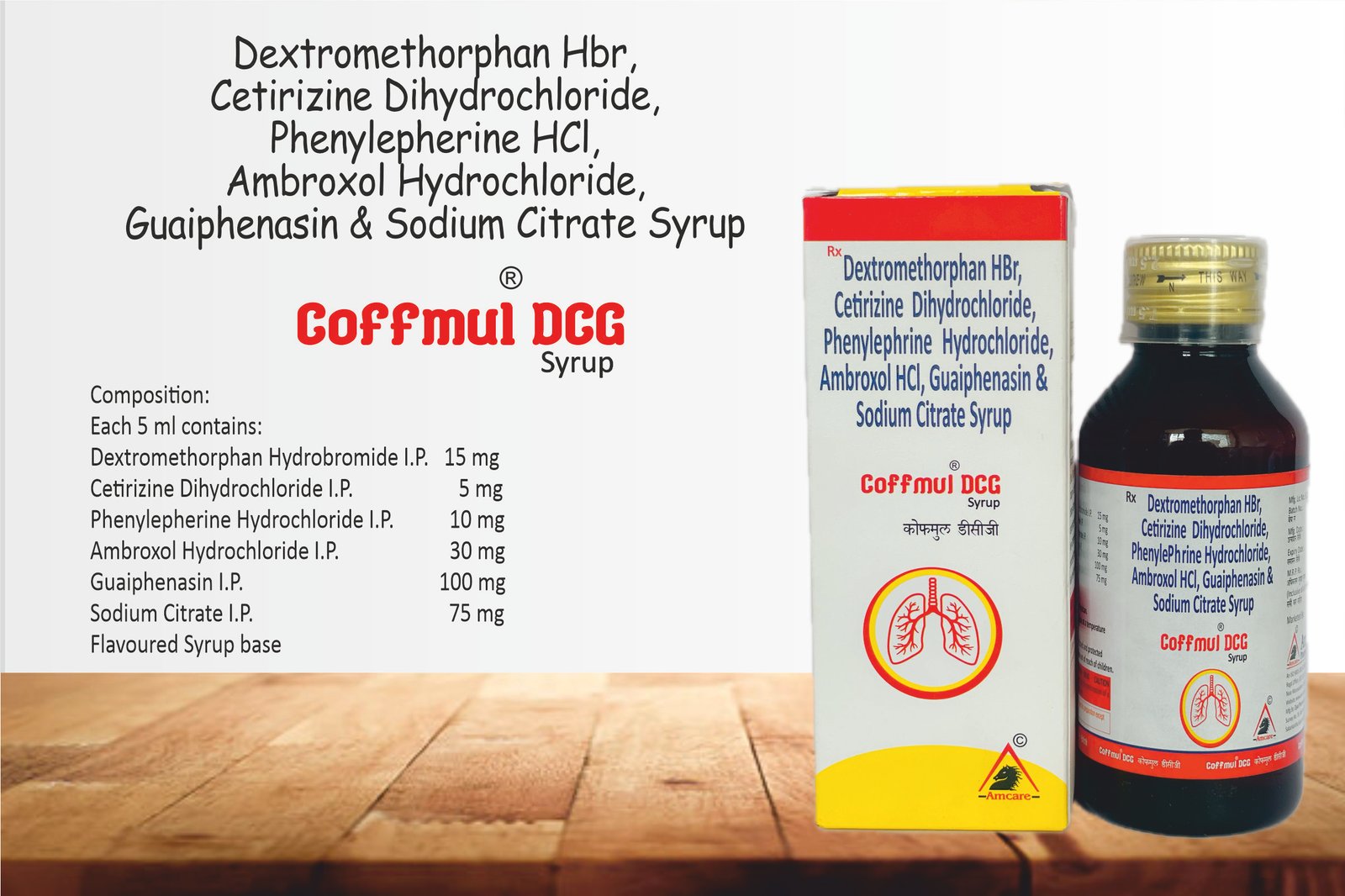
Coffmul®DCG
Product Composition
Packaging Details
Product Description
COFFMUL DCG Syrup – Complete Product Information
1. Product Overview
COFFMUL DCG Syrup by Amcare Pharmaceuticals is a combination oral respiratory formulation containing Dextromethorphan Hydrobromide, Cetirizine Dihydrochloride, Phenylephrine Hydrochloride, Ambroxol Hydrochloride, Guaiphenesin and Sodium Citrate.
According to the supplied product artwork, each 5 mL contains:
-
Dextromethorphan Hydrobromide IP – 15 mg
-
Cetirizine Dihydrochloride IP – 5 mg
-
Phenylephrine Hydrochloride IP – 10 mg
-
Ambroxol Hydrochloride IP – 30 mg
-
Guaiphenesin IP – 100 mg
-
Sodium Citrate IP – 75 mg
-
Flavoured Syrup Base – Q.S.
The formulation combines a cough suppressant, antihistamine, nasal decongestant, mucolytic, expectorant and an ingredient used as a mucus-modifying agent.
Important: The strengths above are transcribed from the supplied artwork. The image does not establish the complete approved indications, age restrictions, dosing schedule, pack size or full excipient list for the marketed product.
3. What is COFFMUL DCG Syrup?
COFFMUL DCG Syrup is a multi-ingredient cough and cold formulation intended to address selected respiratory symptoms. Amcare Pharmaceuticals’ published product page lists the same six ingredients and a 100 mL pack.
The formulation contains ingredients with different roles:
-
Dextromethorphan: Temporarily suppresses the cough reflex.
-
Cetirizine: An antihistamine that helps relieve sneezing, runny nose and other allergy symptoms.
-
Phenylephrine: A nasal decongestant intended to relieve nasal stuffiness.
-
Ambroxol: A mucolytic that helps loosen thick respiratory secretions.
-
Guaiphenesin: An expectorant that helps thin mucus so it can be coughed up more easily.
-
Sodium Citrate: Described in Amcare’s product information as supporting mucus thinning.
Together, these ingredients provide cough-suppressant, antihistamine, decongestant, mucolytic and expectorant actions.
Important: The combination is not necessarily suitable for every kind of cough. The appropriateness of suppressing cough while also promoting mucus clearance must be assessed clinically.
4. Active Ingredient Profile
A. Dextromethorphan Hydrobromide IP — 15 mg/5 mL
Dextromethorphan is a non-opioid antitussive used for temporary relief of certain types of cough.
Main role: Cough suppression
It acts on neural pathways involved in the cough reflex and may temporarily reduce coughing associated with certain respiratory conditions. It does not cure the underlying illness or necessarily speed recovery.
Potential symptom areas include:
-
Irritating cough
-
Cough associated with a common cold
-
Repeated coughing episodes
-
Selected non-productive cough conditions
Precaution: Excessive doses can cause serious adverse effects. Dextromethorphan also has important drug interactions, particularly with monoamine oxidase inhibitors (MAOIs) and certain other medicines.
B. Cetirizine Dihydrochloride IP — 5 mg/5 mL
Cetirizine is an antihistamine that blocks the action of histamine, a chemical involved in allergic symptoms.
Main role: Allergy symptom relief
It may help relieve:
-
Sneezing
-
Runny nose
-
Nasal itching
-
Itchy nose or throat
-
Watery or itchy eyes associated with allergy
Cetirizine may cause drowsiness or tiredness in some people.
C. Phenylephrine Hydrochloride IP — 10 mg/5 mL
Phenylephrine is a sympathomimetic nasal decongestant.
Main role: Nasal decongestion
It is intended to reduce nasal congestion by acting on blood vessels in the nasal passages.
Potential symptom areas include:
-
Stuffy nose
-
Nasal congestion associated with selected cold symptoms
-
Nasal congestion associated with certain allergic conditions
Precaution: Phenylephrine requires care in patients with high blood pressure, heart disease and other conditions that may be affected by sympathomimetic medicines.
D. Ambroxol Hydrochloride IP — 30 mg/5 mL
Ambroxol is a mucolytic medicine used for selected respiratory conditions associated with thick or difficult-to-clear mucus.
Main role: Mucus thinning
It helps reduce mucus viscosity and supports the clearance of respiratory secretions.
Potential roles include:
-
Helping loosen thick mucus
-
Supporting the clearance of respiratory secretions
-
Making phlegm easier to expectorate
-
Supporting the management of selected mucus-producing respiratory conditions
Ambroxol should be used according to the approved product information. Rare serious allergic and skin reactions have been reported with ambroxol-containing medicines.
E. Guaiphenesin IP — 100 mg/5 mL
Guaiphenesin is an expectorant used to help relieve chest congestion.
Main role: Expectorant / Mucus clearance
It helps thin mucus in the airways, making it easier to cough up and clear.
Potential roles include:
-
Helping loosen respiratory mucus
-
Supporting expectoration
-
Helping clear thick secretions
-
Relieving symptoms associated with chest congestion
Guaiphenesin provides symptomatic relief; it does not treat the underlying cause of respiratory illness.
F. Sodium Citrate IP — 75 mg/5 mL
Sodium Citrate is included in the supplied formulation.
5. What is COFFMUL DCG Syrup Used For?
Based on the pharmacological roles of the ingredients, COFFMUL DCG may be considered for selected respiratory symptoms when the combination is clinically appropriate and consistent with its approved indications.
Cough
Dextromethorphan provides temporary cough suppression.
Sneezing and Runny Nose
Cetirizine helps manage histamine-mediated allergy symptoms.
Nasal Congestion
Phenylephrine provides the nasal decongestant component.
Thick Mucus and Chest Congestion
Ambroxol, Guaiphenesin and Sodium Citrate are included in the formulation to support mucus thinning and clearance.
Selected Cough and Cold Symptoms
Amcare’s published product description positions COFFMUL DCG for multiple cough and cold symptoms, including cough, nasal congestion, allergy-related symptoms and thick mucus.
6. How Does COFFMUL DCG Work?
The formulation contains six ingredients with different roles.
Dextromethorphan → Cough Suppression
Cough stimulus
↓
Dextromethorphan acts on central cough pathways
↓
Temporary reduction in the urge to cough
Cetirizine → Antihistamine Action
Histamine-mediated allergic symptoms
↓
Cetirizine blocks H1 histamine receptors
↓
Relief of sneezing, runny nose and itching
Phenylephrine → Nasal Decongestion
Swelling of the nasal blood vessels
↓
Phenylephrine’s decongestant action
↓
Potential reduction in nasal stuffiness
Ambroxol → Mucolytic Action
Thick respiratory secretions
↓
Ambroxol helps reduce mucus viscosity
↓
Mucus becomes easier to clear
Guaiphenesin → Expectorant Action
Respiratory mucus
↓
Guaiphenesin helps thin secretions
↓
Mucus becomes easier to cough up
Sodium Citrate → Mucus-Modifying Support
Sodium Citrate is included as an additional ingredient described by the manufacturer as supporting mucus thinning.
Combined Action
|
Ingredient |
Principal role |
|---|---|
|
Dextromethorphan |
Cough suppressant |
|
Cetirizine |
Antihistamine |
|
Phenylephrine |
Nasal decongestant |
|
Ambroxol |
Mucolytic |
|
Guaiphenesin |
Expectorant |
|
Sodium Citrate |
Mucus-modifying support, as described by the manufacturer |
7. Product Highlights
Six-ingredient formulation: Combines Dextromethorphan, Cetirizine, Phenylephrine, Ambroxol, Guaiphenesin and Sodium Citrate.
Cough-suppressant action: Dextromethorphan temporarily reduces the urge to cough.
8. Dry Cough vs. Productive Cough
Understanding the type of cough helps determine whether a combination product is appropriate.
Dry or Non-productive Cough
A dry cough produces little or no mucus.
Dextromethorphan may be used for temporary cough suppression when clinically appropriate.
Productive or Wet Cough
A productive cough brings up mucus or phlegm.
Ambroxol and Guaiphenesin support mucus thinning and clearance, but suppressing a productive cough is not necessarily appropriate in every patient.
COFFMUL DCG
Because this formulation combines a cough suppressant with mucus-clearing ingredients, it should not automatically be recommended for every cough.
The type of cough, amount of mucus, underlying diagnosis and approved indication should be considered before treatment.
9. Dosage and Administration
The appropriate dose and duration of COFFMUL DCG must be determined from the approved product information and healthcare professional’s instructions.
The supplied artwork provides the composition per 5 mL but does not show a complete dosing schedule.
General administration precautions:
-
Measure each dose accurately using a suitable medicine-measuring device.
-
Do not use an ordinary household spoon for precise measurement.
-
Follow the prescribed dose, frequency and treatment duration.
-
Do not exceed the recommended dose.
-
Do not combine with another cough or cold preparation without checking the ingredients.
-
Seek medical advice if symptoms persist or worsen.
Do not infer a paediatric dose from the concentration alone. The patient’s age, clinical condition and approved product instructions must all be considered.
10. Important Safety Information
Avoid Duplicate Ingredients
Other cough, cold and allergy medicines may contain overlapping ingredients.
Check for:
-
Dextromethorphan in another cough suppressant
-
Cetirizine or another antihistamine in an allergy or cold medicine
-
Phenylephrine or another decongestant
-
Ambroxol or Guaiphenesin in another mucus-clearing product
MedlinePlus advises checking combination cough and cold medicines carefully to avoid accidentally taking the same active ingredient more than once.
Drowsiness
Cetirizine can cause drowsiness or tiredness in some people. Caution is appropriate with driving, machinery and activities requiring alertness.
Cardiovascular Precautions
Phenylephrine warrants caution in people with hypertension, heart disease and other conditions affected by decongestants.
Drug Interactions
Dextromethorphan has important interactions with MAOIs and certain other medicines. Inform the healthcare professional about all current medicines before use.
11. Possible Side Effects
Potential adverse effects may arise from one or more ingredients.
Dextromethorphan-related effects
Possible effects include:
-
Dizziness
-
Drowsiness
-
Nausea
-
Vomiting
Excessive doses can cause serious toxicity.
Cetirizine-related effects
Possible effects include:
-
Drowsiness
-
Tiredness
-
Dry mouth
Phenylephrine-related effects
Potential effects can include:
-
Nervousness
-
Dizziness
-
Sleep disturbance
-
Cardiovascular effects in susceptible individuals
Ambroxol-related effects
Possible effects include gastrointestinal discomfort and hypersensitivity reactions. Rare serious skin reactions have also been reported.
Guaiphenesin-related effects
Possible effects include nausea, vomiting or headache.
12. Precautions
Medical advice should be obtained before use in patients with:
-
High blood pressure or heart disease
-
Thyroid disorders
-
Diabetes
-
Kidney or liver impairment
-
Glaucoma or difficulty passing urine
-
Persistent or unexplained cough
-
Known hypersensitivity to any ingredient
-
Ongoing treatment with antidepressants or other medicines that may interact
The complete contraindications and precautions should be checked against the current approved package insert.
13. Drug Interaction Considerations
Monoamine Oxidase Inhibitors (MAOIs)
Dextromethorphan should not be combined with MAOIs or used within the applicable washout period after stopping them.
Other Antidepressants
Some medicines affecting serotonin may interact with dextromethorphan. Professional review is important before combining treatments.
Other Antihistamines
Cetirizine combined with other antihistamines can increase unwanted effects such as drowsiness.
Other Decongestants
Combining phenylephrine with another sympathomimetic decongestant may increase adverse-effect risks.
Other Cough and Cold Medicines
Check ingredient lists carefully to avoid duplicate doses.
14. Use in Children
The supplied artwork does not establish a specific minimum age or age-wise dosing schedule for COFFMUL DCG.
India’s Ministry of Health advisory dated 3 October 2025 states that cough and cold medicines should not be prescribed or dispensed to children under two years and are generally not recommended for children below five years. Use in older children should follow careful clinical evaluation, supervision, appropriate dosing and avoidance of unnecessary multiple-drug combinations.
Before publishing paediatric-use claims for COFFMUL DCG, verify:
-
The approved minimum age
-
The authorised indication
-
The appropriate dose and duration
-
Product-specific contraindications and warnings
Do not describe the product as suitable for all children or infants without supporting approved product information.
15. When to Consult a Doctor
Medical evaluation is recommended if a cough:
-
Persists or gets worse
-
Is associated with difficulty breathing
-
Is accompanied by chest pain
-
Produces blood
-
Occurs with persistent or high fever
-
Is associated with significant wheezing
-
Causes marked weakness or other concerning symptoms
Severe breathing difficulty or suspected overdose requires urgent medical attention.
16. Storage and Handling
Store COFFMUL DCG according to the conditions stated on the approved product label.
General precautions include:
-
Keep the bottle tightly closed.
-
Protect from excessive heat and direct sunlight.
-
Keep out of reach of children.
-
Check the expiry date before use.
-
Do not use if the bottle or seal is damaged.
-
Follow the manufacturer’s instructions for storage after opening.
The exact storage temperature and in-use shelf life should be confirmed from the approved product information.
17. Packaging Information
The supplied artwork shows:
-
Dark pharmaceutical bottle
-
Golden-coloured screw cap
-
White label with red and blue accents
-
Lung illustration
-
COFFMUL DCG Syrup branding
-
Amcare Pharmaceuticals logo
Amcare’s published product page lists the pack size as 100 mL