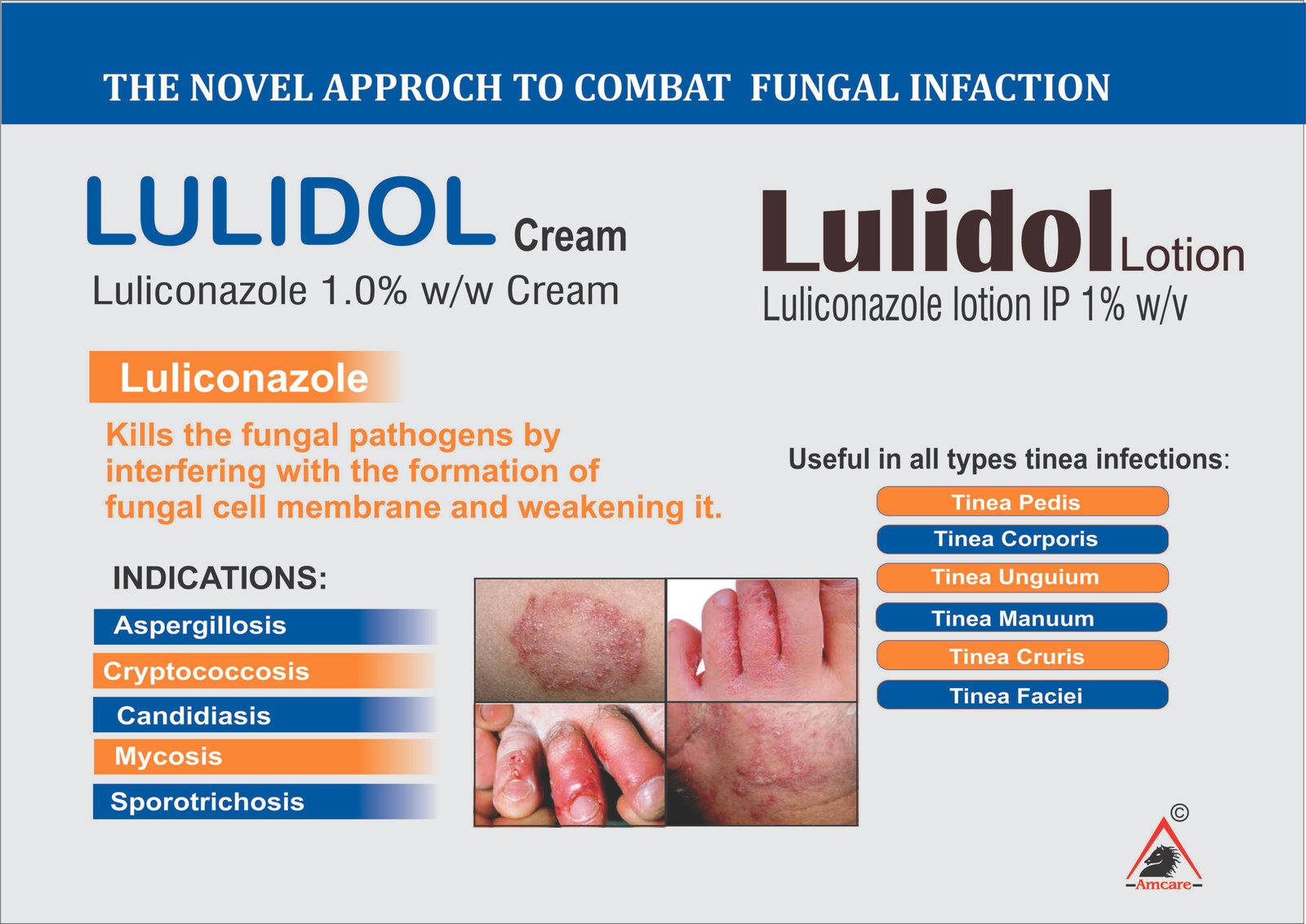
Our Products
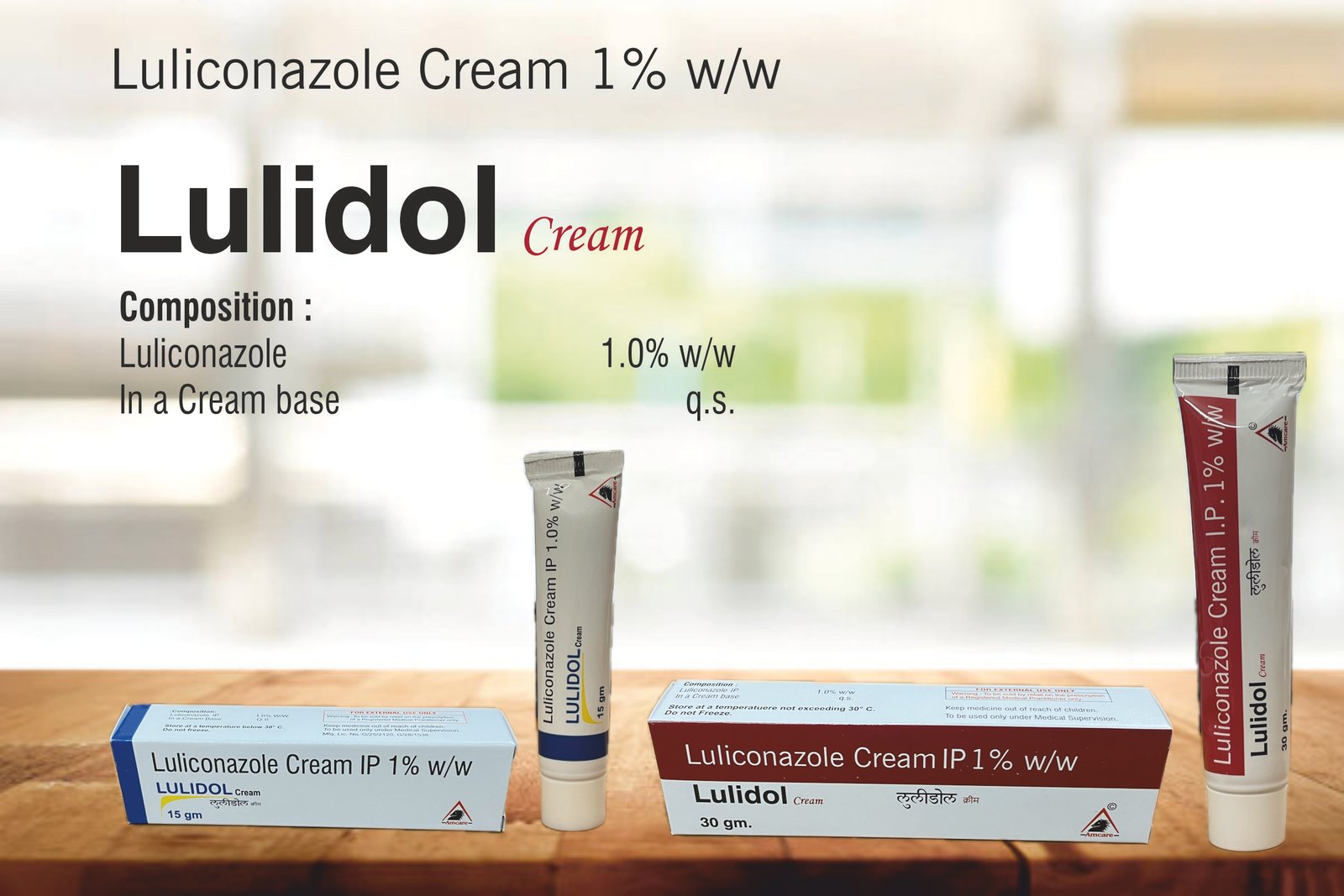
Lulidol
Product Composition
Packaging Details
Product Description
Lulidol Cream – Complete Product Information
Lulidol Cream by Amcare Pharmaceuticals contains Luliconazole 1% w/w, a topical antifungal medicine used to treat certain fungal skin infections. The supplied product artwork shows two pack sizes: 15 g and 30 g.
Luliconazole is an imidazole antifungal that works by interfering with fungal cell membrane formation. Treatment should be selected according to the type and location of the infection.
1. Lulidol Cream Composition
|
Ingredient |
Strength |
|---|---|
|
Luliconazole |
1.0% w/w |
|
Cream base |
q.s. |
Active ingredient: Luliconazole 1% w/w.
2. Product Details
|
Product Information |
Details |
|---|---|
|
Brand Name |
Lulidol Cream |
|
Generic Name |
Luliconazole |
|
Strength |
1% w/w |
|
Dosage Form |
Cream |
|
Route |
Topical / external application |
|
Pack Sizes |
15 g and 30 g |
|
Therapeutic Category |
Topical antifungal |
|
Company |
Amcare Pharmaceuticals |
3. What Is Lulidol Cream Used For?
Luliconazole cream is used to treat certain fungal skin infections caused by susceptible fungi.
Athlete’s Foot (Tinea Pedis)
A fungal infection commonly affecting the feet and the spaces between the toes. Symptoms may include itching, scaling, redness and cracking.
Jock Itch (Tinea Cruris)
A fungal infection affecting the groin and inner thighs, often causing an itchy, red or scaly rash.
Ringworm of the Body (Tinea Corporis)
A fungal skin infection that may cause circular or expanding patches with a scaly border.
Important: Lulidol Cream is an antifungal medicine, not a general-purpose cream for every rash, bacterial infection or unexplained itching.
4. How Does Lulidol Cream Work?
Luliconazole inhibits the fungal enzyme lanosterol 14α-demethylase, which is involved in ergosterol synthesis. Ergosterol is an essential component of fungal cell membranes.
By disrupting fungal cell membrane formation, luliconazole helps inhibit susceptible fungi and treat the infection.
5. Dosage and Administration
The appropriate application schedule depends on the type and location of the infection and the approved product instructions.
For reference, prescribing information for certain luliconazole 1% cream products specifies:
-
Tinea pedis: Once daily for 2 weeks.
-
Tinea cruris: Once daily for 1 week.
-
Tinea corporis: Once daily for 1 week.
These schedules are based on specific product labels and should not automatically be assumed to be the approved regimen for every Lulidol product. Confirm the current package insert and follow the prescribing healthcare professional’s instructions.
6. How to Apply Lulidol Cream
-
Clean and gently dry the affected area.
-
Apply a thin layer to the affected skin and the surrounding area as directed.
-
Avoid contact with the eyes, mouth and other mucous membranes.
-
Wash your hands after application unless treating your hands.
-
Complete the prescribed treatment course, even if symptoms improve earlier.
Do not use the cream for longer than directed without medical advice.
7. Possible Side Effects
Luliconazole cream is generally used locally, but adverse effects may occur.
Possible side effects include:
-
Mild burning or stinging
-
Irritation at the application site
-
Redness
-
Itching
-
Contact dermatitis
Stop using the product and seek medical advice if severe irritation, swelling or signs of an allergic reaction develop.
8. Precautions and Warnings
Before using Lulidol Cream:
-
Inform your healthcare professional about any known allergy to luliconazole or formulation ingredients.
-
Use it only for the skin condition for which it is prescribed.
-
Avoid contact with the eyes and mucous membranes.
-
Do not apply it to open wounds unless specifically directed.
-
Seek medical review if the condition worsens or does not improve as expected.
Avoid self-diagnosing every itchy or scaly rash as a fungal infection.
9. Drug Interactions
Systemic absorption of topical luliconazole is generally limited when used as directed, so systemic drug interactions are less likely. Nevertheless:
-
Inform your healthcare professional about other topical medicines used on the same area.
-
Avoid combining multiple medicated creams without advice.
-
Follow the product-specific prescribing information.
10. Lulidol Cream During Pregnancy
Consult a healthcare professional before using Lulidol Cream during pregnancy. The decision should consider the expected benefit, potential risk and the approved product information.
11. Lulidol Cream During Breastfeeding
Ask your healthcare professional before use while breastfeeding. Do not apply the cream to the nipple or an area that may come into direct contact with the infant unless specifically directed.
12. Who Should Seek Medical Advice Before Using Lulidol Cream?
Medical evaluation is appropriate for people with:
-
Extensive or recurrent fungal infections
-
A rash of uncertain cause
-
Signs of a secondary bacterial infection
-
Severe skin irritation or open wounds
-
Symptoms that persist or worsen despite treatment
-
A history of allergy to the product’s ingredients
13. Key Features of Lulidol Cream
1. Luliconazole 1% w/w
Contains a topical imidazole antifungal.
2. Targeted Antifungal Action
Acts against susceptible fungi responsible for certain superficial skin infections.
3. Convenient Topical Formulation
Cream formulation for external application.
4. Two Pack Sizes
Available in 15 g and 30 g packs, as shown in the supplied artwork.
5. Amcare Pharmaceuticals
Branded as Lulidol Cream by Amcare Pharmaceuticals.
14. Why Choose Lulidol Cream by Amcare Pharmaceuticals?
Lulidol Cream offers:
-
Luliconazole 1% w/w
-
Topical antifungal formulation
-
Cream base
-
15 g and 30 g pack options
Use the product according to the approved indication and prescribing instructions. Confirm the exact approved product information before making therapeutic claims in commercial material.